Remembering Legendary Hamptons Artist Lester Johnson
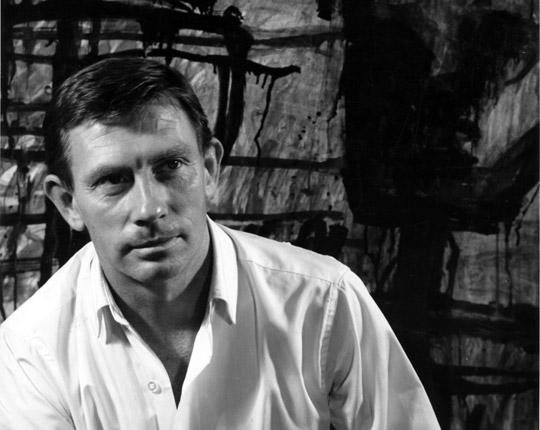
Having spent summers growing up in my grandparents’ house in Springs, it was not until much later that I realized what it meant to be an artist there in the ’50s and ’60s. The paint-speckled floor of the second-floor studio was where we camped out, with cots and sleeping bags, and, it being the country, spiders. The ceiling had a massive skylight—ideal for an artist, less ideal during August thunderstorms.
The house had undergone a few changes since Lester and Josephine Johnson first bought the property on Old Stone Highway in 1954. The land was sold to them from the next-door neighbor, Mr. Fields, a bayman who had a massive scallop shell pile back in the woods behind the house. Lester and Jo built the house from the ground up, with the help of Jo’s father and uncle, who helped dig to access well water, which was then brought up with a small hand pump. The house was a ranch at first, and the “studio” was a barrack-like shack in the backyard.
Lester loved the land because of the locust trees, which he captured in many of his watercolors in the ’90s. In the early years in Springs, to support his family, he would go clamming in Accabonac Bay and then sell his findings out of a bucket at the end of the road. People who bought the clams would send a check in the mail.
In the mornings, Lester would bicycle to Daniel T. Miller General Store (now Springs General Store) to pick up food for the day. From time to time, they’d drive to Southampton to go shopping, and to Sag Harbor to see a movie, or to pick something up from Mrs. Epstein’s Dry Goods store in East Hampton.
He spent time painting with ink and a sketchbook at Barnes Landing, Louse Point and Albert’s Landing, and back at the studio with oil and canvas; creating paintings similar to those he was working on in the city—dark, figurative images in heavy impasto.
In March of 1961, ARTNews ran an article by Lawrence Campbell, with photographs by Robert Frank, titled “Lester Johnson Paints A Picture” (a series that began in 1953 with “de Kooning Paints A Picture”). Describing his process and his tendency to destroy and rework a painting, Campbell wrote, “But coming on to it from a night’s sleep, he will see it not as full and rich, but as smaller, weaker, thinner than the night before. This revelation may come as a great shock. It is a call to arms. Suddenly he will feel free to wreck the image with a vengeance. He will replace it with an entirely new one, reworking every inch of the surface and all at high speed.”
Reflecting (and participating in) a certain Ab-Ex freedom, Lester told Campbell, “It is as though I had fought my way out from behind my own personality, and was able at last to expand and express myself in a completely fresh way. When the painting is finished, I realize I can never repeat it. It came from a moment of absolute freedom. The moment came when I was able to set down a statement in paint which was the sum of the statements that preceded it.”
Taking part in the physicality of “action painting,” as described by critic Harold Rosenberg in 1952, Lester nonetheless set himself apart from his Abstract Expressionist peers by not only including the figure in his work, but making the human figure his vehicle for expression throughout his career.
The East Hampton art scene Lester and Jo took part in consisted of occasional cocktail parties with other artists, visits with neighbors like Rosenberg or Saul Steinberg, a drive once with Robert Frank and Jack Kerouac to Jungle Pete’s down the road, meeting Bill de Kooning and his daughter Lisa at Louse Point, or spending the day with Paul Georges and his wife and kids. On Sundays, the artists would gather at the one of the ocean beaches, usually Georgica or the “Potato Beach.” No parking permit was required and the beaches were empty.
In the mid-’90s, he painted a “Summer Scene” series based on the people he saw sitting at East Hampton Point. Quite different from his all-black paintings from the early ’60s, “Summer Scene #5” (1996) is particularly interesting in that it reveals many of the transitions that were made along the way—the inclusion of wavy-haired women, dramatic angles of arms and legs and intricacy of design within the fabrics, all in the greater pursuit of movement. In typical Johnson fashion, adhering to the “truth” of the canvas, he leaves the feet loosely painted with lots of dripping paint. However, this series, different in its slightly unfinished, watery quality and unusual colors (turquoise, blues, lavenders, and browns) leaves me certain that the water and distinctive light at Three Mile Harbor had its influence.
The South Fork underwent enormous changes during Lester’s lifetime. It’s hard to imagine witnessing the evolution from farmland to “playground for the rich and famous.” Through it all, he continued working on the East End during summers, eventually settling year-round in Southampton Village in 2006, where he spent his remaining years. Lester died on May 30, 2010, at the age of 91. An influence on a generation of younger artists as well as his contemporaries, his legacy as a leading Figurative Expressionist continues, and his work is in the permanent collections of both the Parrish Art Museum and Guild Hall. As a grandfather and as a person, he will be remembered as much for his career as for his sincerity and gentle nature.
Upcoming exhibitions of Lester Johnson’s work include:
Pioneers of Provincetown: The Roots of Figurative Expressionism, Provincetown Art Association and Museum, Provincetown, July 19–September 2, 2013.
Summer Salon, ACME Fine Art, Boston, July 5–August 17, 2013.
Lester Johnson: Dark Paintings, Steven Harvey Fine Arts Projects, New York, November 2013.
To see more of Lester Johnson’s work, visit lesterjohnson.com.

Vetted Hamptons Resources