‘Valley Forge’: Artfully Done
 By Joan Baum

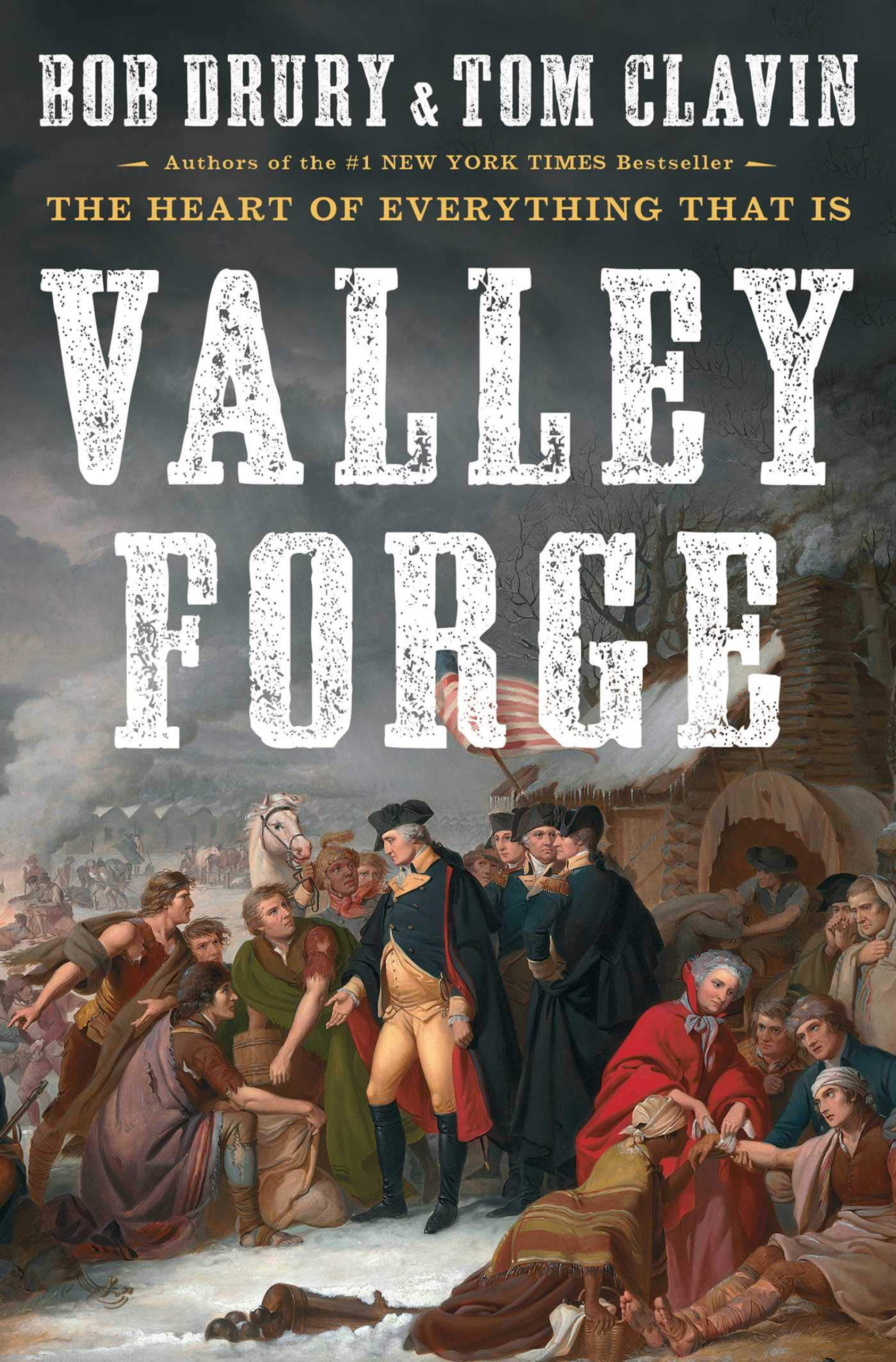
This well researched, literate, readable, and moving reassessment of one of our country’s most iconic figures — General George Washington, who commanded the ragtag Continental Army during the desperate winter of 1777-78 at Valley Forge, PA — should prompt reconsideration of the way American history is presented in schools. Not to mention altering the way Washington himself is perceived.
Blame the 1796 Gilbert Stuart late-life portrait of our first president (d. 1799) which may still dominate many a school auditorium, and the apocryphal story about the cherry tree and Washington’s never telling a lie. The truth about this “larger than life” man at the military encampment 23 miles from Philadelphia to which he moved his men after the British captured Philadelphia, is much more complex, as Tom Clavin and Bob Drury show in their remarkable new book, “Valley Forge,” arguably their finest collaboration.
Drury and Clavin, long-time partners writing on memorable moments and men in American history, are hardly the first to argue against simplistic stereotypes (the Valley Forge winter, for example, was not, as legend and paintings have it, the coldest ever), but they are impressively persuasive in putting forth a detailed reevaluation of that horrific time (practically no food, no clothing, no shelter, a plethora of diseases and desertions, heartfelt traitors, and mercenaries for hire). And a reevaluation of “the father of our country.”
The theme of their well-documented narrative is that Valley Forge represented a critical point in the war, becoming “the greatest and most costly symbolic victory of the revolution.” It was the endurance of the men surviving that winter that changed the way the rebellion and Washington were regarded at home and abroad.
Battles had been lost, particularly in New York, and the capitol of the country was in enemy hands, but survival at Valley Forge, despite Congressional incompetence and indifference, as well as political machinations in Europe, brought in the French as allies, even though fighting would go on for five more years, primarily in the southern colonies, until Lord Cornwallis surrendered at Yorktown, VA.
Generously crediting scholars who came before them, Clavin and Drury make their point because they are thorough and fair, presenting alternative views and acknowledging paucity or inconclusiveness of evidence.
Their footnotes, alone, are fascinating. Did we know that the “gin” in Cotton Gin was a shortened form of “engine”? That “gerrymander” comes from a play on the name of Massachusetts statesman Elbridge Gerry (vice president under Madison) who schemed to redraw boundaries of electoral districts, one of which looked like a salamander? That feuding, corruption, and betrayal at Valley Forge and elsewhere on battlefields, in villages, and at state houses were so rife as to imperil the revolution? That nearly 12,000 American prisoners of war perished in captivity, more than in all the revolutionary battles combined?
But through it all, there was the man Lafayette called “superb,” the man whom too many history books still portray as a middle-aged, childless, aristocratic bewigged leader known for his wooden teeth, dumpy wife, and slave-run estate at Mt. Vernon more than for his “inspirational leadership, serene dignity, and sheer physical presence.” That this man “held the Continental Army together throughout a desperate February is no less than astounding,” the authors write.
Forty-five at the time, Washington was a shrewd and compassionate commander-in-chief, a master military and political strategist who didn’t let “jealous and power-hungry subordinates” get to him, and there were plenty. He was also a man who believed in protocol and courtesy (he had Hamilton send back a dog belonging to Gen. Howe, bathed, collar and all). A fierce believer in civilian control over the military, he ordered his men not to confiscate goods and property from sympathetic locals. And he integrated the army — it was the last time blacks would serve with whites until The Vietnam War.
A good reader of character, Washington secured the affection and devotion of two of the revolution’s most colorful and young patriots — the brilliant polymath and future Secretary of the Treasury Alexander Hamilton (22), he of the elegant handwriting and eloquent prose style (Lin-Manuel Miranda got him spectacularly right), and the daring (Marquis) Marie-Joseph-Paul-Yves-Roch-Gilbert du Motier de Lafayette (19). What a cast of characters — heroic and villainous — and those sitting it out or shifting sides!
Men were drawn into the modest commander’s orbit, among them the waggish, womanizing Francophile Benjamin Franklin and the bursting-to-be-in-charge-of-training, the Prussian bear, Friedrich Wilhelm. And there was Baron Steuben, who whipped the sloppy, inexperienced, fractious, indifferent Continental Army into a disciplined fighting force, tested finally at the climactic June 1778 Battle of Monmouth Courthouse in NJ (maps attractively dot the narrative).
It’s been noted that “Valley Forge” occasionally uses specialized (mostly military) vocabulary. True, and another reason for praising this book. Good literature should make a reader reach and reflect on structure, style, and tone, as well as on content. Drury and Clavin would flatter the reader into following them on their aesthetically informed historical terms: “Come sunset the downpours froze into a wet, heavy snow that virtually interred the men, Bruegel’s peasants bathed in a Rembrandt gloom.” Artfully done.
Vetted Hamptons Resources