Meet Herb Strobel, Long Island Farm Bureau Board Member
 By Todd Shapiro
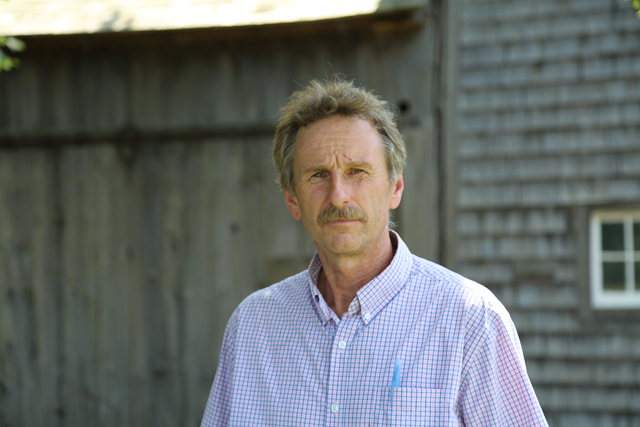
Herb Strobel grew up on a dairy farm in Center Moriches and has been involved in agriculture his entire life. After 20 years in research and teaching, he became the Executive Director of Hallockville Museum Farm in Riverhead for over a decade.
“I loved my time at Hallockville but felt that if the museum was to evolve, others needed to take the lead,” says Strobel, who added that he has fond memories of his time there. “It had gotten to the point that I was Hallockville and Hallockville was me. What the museum needed was new blood and fresh ideas.”
Strobel currently works at the Long Island Horticultural Research and Education Center operated by Cornell University while also continuing to farm in Center Moriches. He enjoys the LIHREC position because he has a direct hand in farming, doing such things as plowing, cultivating, and moving irrigation pipes. “It’s nice way to be involved with agriculture,” Strobel says of his day job. It also is a sort of coming home for Strobel, who once had a work study job while attending Cornell.
While few see his work at LIHREC, farmers have benefitted through Strobel’s efforts on the Board of Long Island Farm Bureau, an advocacy group that is important to local farmers. With nearly 1,000 members, more than half being farmers and farm family members, Farm Bureau’s policy work has helped shape the agricultural and aquaculture landscape of Long Island.
“LIFB works with farmers who have issues with various government entities,” Strobel explained. “We help farmers navigate town codes and new regulations that the County and State are implementing. Ideally, it works best when farmers are brought in during the drafting of new code language. We can help make regulations more farmer friendly or at least minimize negative effects.” Strobel says, “On the East End, farmers are usually still part of the discussion within town government but that’s not always the case as you go more west on the Island.” But regardless of the location, Strobel believes that what is good for farmers is good for Long Island in the long run.
Although Farm Bureau advocates on behalf of commercial farmers, including those who work the land as well as those with aquacultural operations on the water, membership is open to non-farmers as well. “We don’t get that many calls from the public because I don’t think they really know what we do”, said Strobel. “Farm Bureau’s ultimate goal is to help farmers succeed but the support of non-farmers is always welcome”.
“Every state, and most counties across the country have a farm bureau,” Strobel says. “LIFB covers Nassau, Suffolk and the boroughs of New York City. We’re under New York State Farm Bureau umbrella, which is part of the larger American Farm Bureau Federation.”
The ‘farm bureau’ concept actually began in Broome County, New York in 1911 and soon led to a partnership with the Cooperative Extension Service that was created by the United States Department of Agriculture. Local farm bureaus were formed across the country and were directly tied to land-grant colleges and universities within their respective states. Over time, there was an evolution of responsibilities, and in the early 1950s the Extension Service was officially separated from Farm Bureau to focus on educating farmers about research findings. New York Farm Bureau was created in 1955 as an advocacy organization but still closely collaborates with the Cooperative Extension.
“Most of the public doesn’t realize how important LIFB has been to Long Island, especially over the last 50 years”, explains Strobel. For instance, we helped shape the creation of the Suffolk County Farmland Preservation Program in 1973. “Farmers sell development rights to the County, which means the land can then be used only for agricultural purposes”. The sale of development rights to the County and local towns has preserved approximately 20,000 acres across Suffolk. Even fewer people know that LIFB helped led the fight in the 1970s against the construction of two nuclear plants proposed along the Long Island Sound in Jamesport. “This was a great example of grassroots advocacy where local people, including farmers, drew a red line and said we won’t have this in our community”, Strobel says. He went on to note that the physical landscape of the entire eastern half of Long Island would have been dramatically different had LIFB lost the battle in Jamesport.
The Strobel family affiliation with Farm Bureau goes back nearly 100 years when his great uncle first became a member at a time when there were many farmers in the Moriches area and across Long Island. “Today, less than 2% of the population live on farms,” Strobel explained of the importance of Farm Bureau, “and most people’s only direct contact with farmers is at a farmstand. If you want to know what fruits and vegetables are supposed to taste like, go to a local stand and enjoy spring asparagus that hasn’t been transported across the country for days, taste a fresh-picked strawberry, or corn that is cooked just a few hours after being picked.”
Strobel says it is the Farm Bureau and other agriculture-related organizations that help ensure farming remains strong on Long Island and across the country. For more information about the Long Island Farm Bureau, visitlifb.com or call 631-727-3777.
Todd Shapiro is an award-winning publicist and associate publisher of Dan’s Papers.
Vetted Hamptons Resources