
Review: Fahrenheit 451 at Bay Street Highlights the Perils of Authoritarianism


Ray Bradbury’s Fahrenheit 451 is often cited as one of the 20th century’s most important works of dystopian fiction. Along with Aldous Huxley’s Brave New World and George Orwell’s 1984, Bradbury’s novel is part of a Holy Trinity of cautionary tales imagining a future where shared, objective truth is erased by an authoritarian state.
Now Bradbury’s most famous work gets a powerful and audacious new production at Bay Street Theater.
Fahrenheit 451 is a work that resonates with contemporary audiences because it feels less like some impossible futuristic morality tale and more like a warning to today’s world – particularly to today’s America.
Bradbury’s novel was written at least partly as a response to the McCarthy hearings of the 1950s. But book burnings and censorship, a seemingly endless assault on the truth and the creation of a manufactured, state-sponsored reality aided by electronic means are all developments that could easily be taken directly from today’s headlines.
“When Ray Bradbury wrote Fahrenheit 451 in 1953, he called it fiction,” director Stephen Hamilton says in the play’s production notes. “He imagined a world in which books were banned, critical thought was discouraged and citizens numbed themselves with electronic screens and endless entertainment. In 2025, his vision feels alarmingly close to home.”
Hamilton contends that the very act of staging Bradbury’s play in today’s political environment is a statement unto itself.
“In bringing a play to life, the actors, designers, administrators – all the team members at Bay Street Theater – are tasked with the mission of presenting a story and keeping it alive,” the director writes. “But with Fahrenheit, this question goes to the heart of Bradbury’s vision: What does it mean to memorize – to carry words within us so they can never be destroyed? Each rehearsal, in fact, becomes an act of preservation and a celebration of storytelling as resistance.”
Hamilton, who is also Bay Street’s cofounder, consistently makes choices that highlight the play’s prescience while ratcheting up its intensity. You can feel his assured, decisive hand in scene after scene as he and his cast and crew breathe life into a world where, rather than putting out fires, firemen are tasked with tracking down books – which are illegal to read or own – and setting them ablaze.
Scenic and projection designer Mike Billings and sound designer David Brandenburg also deserve kudos. With its walls of projection screens and all but barren stage spreading out beneath it, Billings’ set somehow manages to feel minimalist and maximalist at the same time. And Brandenburg’s eerie and sometimes startling sonic landscape inhabits every corner of the theater, adding important texture and emotion to the story.
Published in 1953 and adapted by Bradbury for the stage some 25 years later, the play hews closely to the original book, though it does make a few notable changes to the ending and the storyline arcs of several pivotal characters. (Bradbury appears to have borrowed some of the changes from Francois Truffaut’s 1966 film adaptation.)
Under Hamilton’s direction, the cast – many of whom play multiple roles – feels very motivated.
As fireman Guy Montag, the play’s primary protagonist, John Kroft deftly shows us both the external angst and the inner turmoil of a man whose eyes are opening, probably for the first time in his life. As Montag’s search for knowledge and truth overtakes blind obedience to the state and the sadistic thrill he gets from inflicting pain on strangers, Kroft helps the audience feel the weight of his burgeoning self-awareness.
There’s a thirstiness to Kroft’s performance. Whatever his weaknesses may be – and he has plenty of them – Montag comes to a point where he needs to drink from a forbidden fountain of knowledge, consequences be damned. The audience can decide whether or not Montag does enough to atone for his actions and his moral failings. But in Kroft’s hands, his transformation feels like redemption.
Montag’s main foil, Captain William Beatty, is a mass of contradictions. As played by J. Stephen Brantley, the Captain is sometimes hopelessly jaded and laconic. Other times he borders on possessed as he reels off rapid-fire quotes from some of the greatest thinkers in history, while at the same time disdaining the very knowledge and wisdom he gleans from the books he claims not to read.
There are worlds behind the Captain’s eyes. Brantley makes sure we see them. He can go big as needed, but his strength as an actor lies in the subtleties: the way the Captain lights his pipe; the way he reveals important twists in the action in a deadpan, non-threatening tone that belies the existence of very real and very imminent threats.
As the young Clarisse McClellan, Anna Francesca Schiavoni makes the most of her limited stage time. When Montag first meets her, Clarisse is something of an enigma, asking probing questions and wandering around in the wee hours of the night – things one generally doesn’t do in an authoritarian state. Ultimately, Schiavoni’s performance feels wise beyond her years. Clarisse is one of a handful of characters who form the play’s emotional center, and Schiavoni imbues her with a multi-layered, messy humanity.
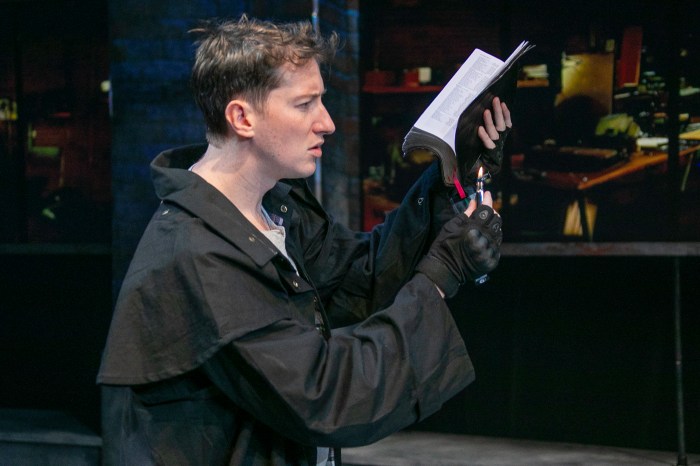
Also excelling in two relatively small but pivotal roles are Matthew Conlon as Professor Faber and Daniela Mastropietro as Montag’s wife, Mildred.
The Professor is a fearful old man who is nevertheless unwilling to submit to the will of an oppressive state. If Clarisse is the character who most makes Montag want to change, Faber is the character who facilitates that change by helping to shepherd Montag’s journey into the light. In a vulnerable and wise performance, Conlon captures not only the Professor’s palpable terror, but also his steely resolve.
Mastropietro, who dazzled last winter as Blanche DuBois in Bay Street’s production of A Streetcar Named Desire, gives the audience a woman who is the embodiment of the state’s insidious efforts to control its population and erase knowledge.
Anesthetized by pills and personalized, government-created reality TV that is beamed onto the wall of screens in a home she never leaves, Mildred is all but paralyzed by the distractions of her age. When she betrays her husband, she does so not out of some misguided patriotism or moral imperative, but rather because she has been fed an endless stream of televised propaganda.
When he wrote Fahrenheit, Bradbury was clearly concerned about the insidious effects of television – particularly as it might be used as a tool of oppression. And while the novel and the play were written long before the advent of the internet and social media, the story is incredibly prescient. Like the best writers of his generation, Bradbury imagined the perils of the online era before they ever existed.
It’s notable that although Fahrenheit 451 has been performed numerous times on numerous stages, both in the United States and internationally, it has never been produced on Broadway. That appears to be changing. Multiple industry sources suggest that Martyna Majok, who won the 2018 Pulitzer Prize for Drama for her play, Cost of Living, is in the process of writing a new stage version with an eye toward a Broadway run sometime in the future.
In the meantime, you can catch Bay Street’s thoughtful, compelling and highly recommended production in Sag Harbor through November 30. Tickets are available at baystreet.org.
Vetted Hamptons Resources