Renoir Drawings at The Morgan: A Seduction by Paper, Light the Secret Architecture of Genius
 By Avalon Ashley Bellos
There are exhibitions one attends out of admiration, obligation, or curiosity. Then there are some exhibitions that behave like invitations — those rare occasions when a museum quietly opens a door and reveals something utterly intoxicating. Renoir Drawings at the Morgan Library & Museum is precisely that sort of invitation, the kind whispered rather than announced. The experience begins the moment you enter the galleries and feel a subtle hum of revelation, as if Renoir himself were drawing you closer, encouraging you to step into the inner sanctum where his first impulses, private vows, and fleeting discoveries were committed to paper long before the world ever saw them.
The drawings form a language of seduction; after all, one could argue that paper and pen have long been the sanctuary of confession. Thus, paper becomes the silent accomplice to Renoir’s longing; charcoal, graphite, pastel, and watercolor become his means of admission. These works were not created for public applause. They were made for the artist alone, functioning as intimate dialogues between mind and hand, moments when he tested a curve, proved a gesture, challenged himself, or surrendered entirely to instinct. The viewer, standing before these sheets, feels almost voyeuristic, as though intruding upon a sacred correspondence that was never intended to be witnessed. The seduction lies in that immediacy. The intimacy lies in knowing that these drawings contain the unguarded versions of an artist whom history has rendered nearly mythic.
Renoir’s life unfurled during a period of seismic cultural transformation. Paris in the 1870s was a city in flux—a place of shifting, shimmering modernization. Industry roared while leisure blossomed. New philosophies pulsed through the cafés and salons. Renoir captured it all, and it was paper that acted as the conduit of truth. In this modern exhibition at the Morgan, the journey begins with his disciplined early academic studies, rooted in the formal rigor demanded by 19th-century artistic training. These sheets possess a tight musculature, with all bone structure and exactitude. They reveal the foundations upon which the later, more fluid Renoir would bloom.
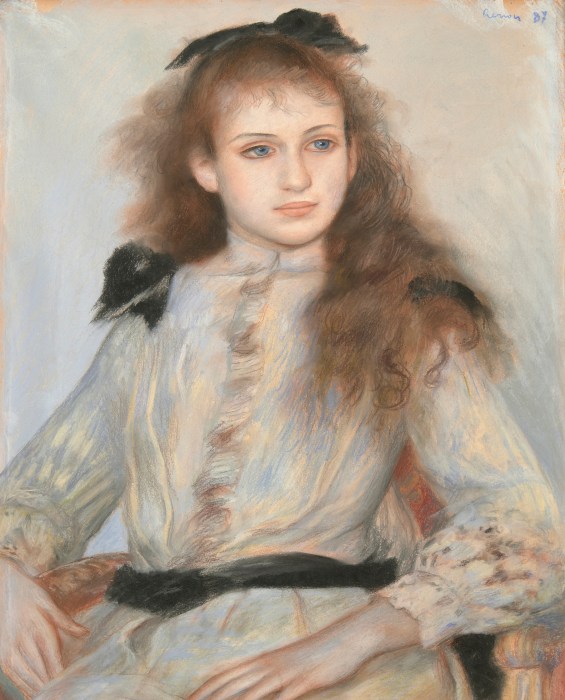
The galleries then widen into the artist’s quicksilver notations of contemporary life—the Parisian promenades, rural interludes, young women illuminated by natural light, working-class figures immortalized with tenderness rather than condescension. The drawings possess a sense of immediacy that feels almost cinematic, capturing human beings mid-motion. These are not drafts so much as witnesses to life as it was lived, vibrating with the energy of a society in transition.
The formal portraits, rendered on paper with surprising gravity, offer a counterpoint to the breeziness of his street and landscape impressions. They demonstrate Renoir’s unrelenting fascination with the human form and his capacity to translate character through the slightest inflection of line. Late in life, as illness complicated his physical freedom, Renoir returned to drawing with heightened devotion. The works from this period possess an extraordinary softness, as though the paper itself were absorbing the wisdom and wistfulness of a man who understood both the urgency and the melancholy of time.
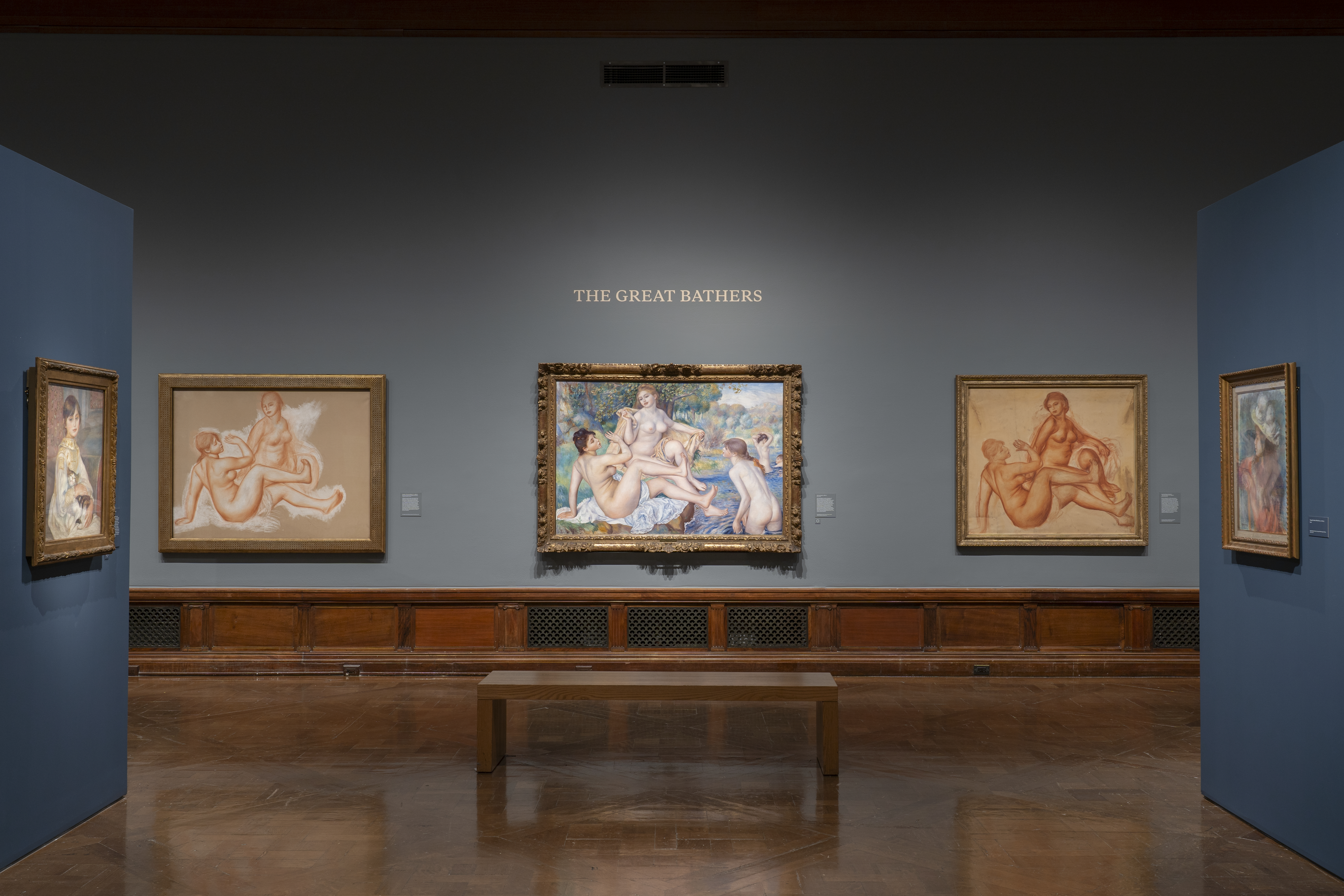
The rarity of this collection forms one of the exhibition’s most compelling triumphs. Gathering nearly one hundred drawings, pastels, watercolors, and prints spanning five decades of artistic evolution constitutes a curatorial achievement of remarkable ambition. The heart of the exhibition is the monumental preparatory drawing for The Great Bathers, a recent gift to the Morgan and a work of extraordinary consequence. Every contour, adjustment, erasure, and reassertion of line reveals the tension between classical structure and the shimmering, liberated sensibility that would define Impressionism.
The collaboration with the Musée d’Orsay deepens the exhibition’s intellectual rigor. Through its thematic organization, the show reveals Renoir not as the painter of “pretty things”—a reduction that has long plagued his legacy—but as a relentless investigator of form, movement, and the human condition.
Visitors leaving Renoir Drawings do not depart with a simple appreciation for a painter’s lesser-known works. They go with the sensation of having been invited into an inner circle, having witnessed the secret architecture of Renoir’s artistic mind.
The exhibition presents a narrative that is both romantic and scholarly, situating the Morgan as the ideal custodian for a body of work that demands both tenderness and intellectual gravity, allowing the public to meet not only the legend but also the man.
The exhibition is on view through February 8, 2026. The Morgan Library and Museum is located at 225 Madison Avenue.
Vetted Hamptons Resources