
Dan's Papers: Getting the News to You
 By Dan Rattiner
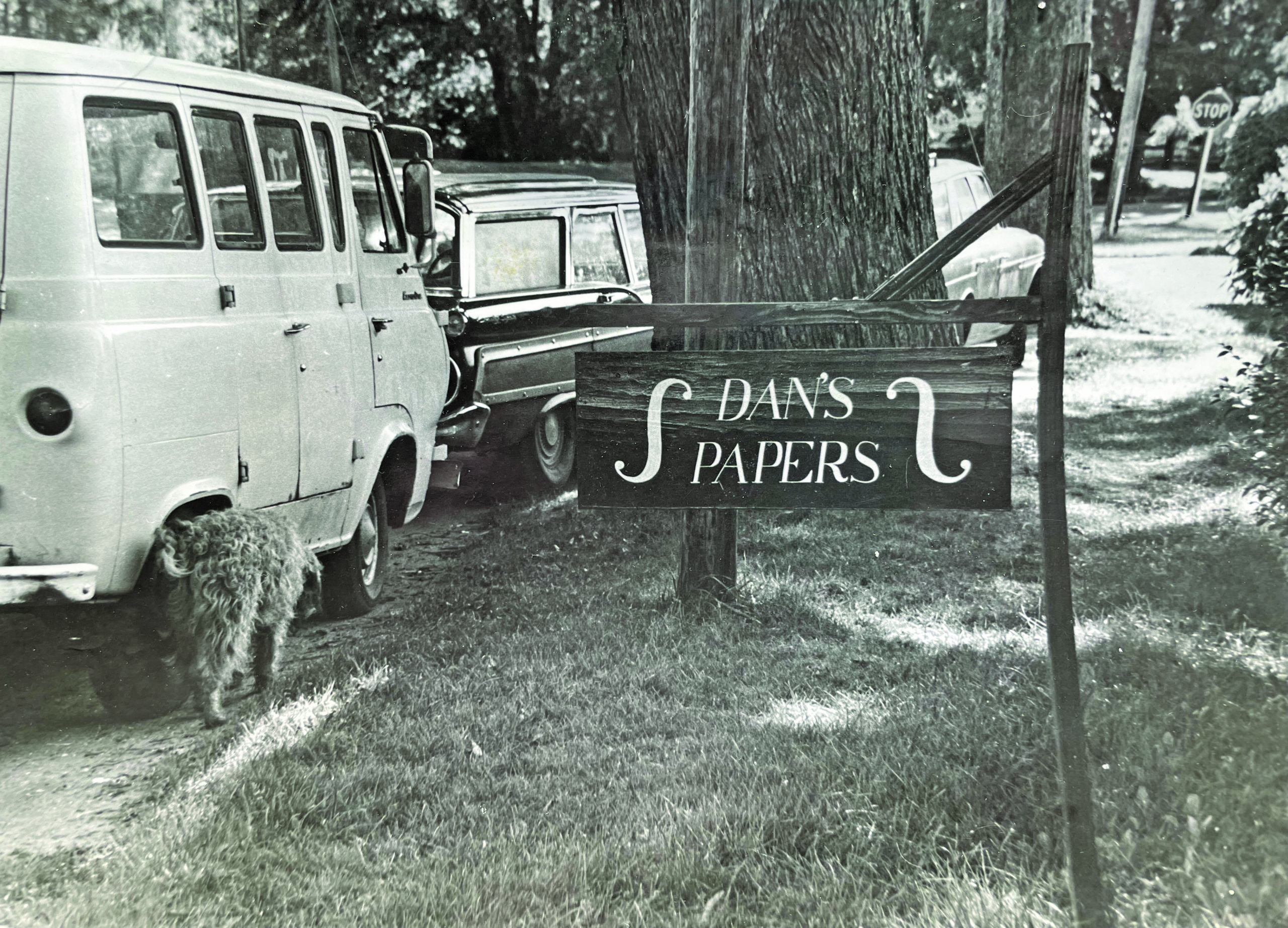
Every week, Dan’s Papers makes good on its promise to deliver the news to you, such as it is. It appears in stacks in motels, in stores, in restaurants and in the lobbies of municipal buildings. Over the 66 years of its existence, new weekly editions have graced the community about 30,000 times.
One just takes for granted that this happens seamlessly and efficiently. And in fact, it has never missed a publication date. But, over the years it has come very close. Here are a few of those occasions.
There was the night I got a phone call at 3 a.m. from the police. The huge delivery van in which our printer packed all of that week’s newspaper bundles failed to make the turn onto Exit 70 of the Long Island Expressway, fell sideways onto its side, and skidded along the road spewing out hundreds and hundreds of bundles of Dan’s Papers — none of which opened but nevertheless caused a big problem for traffic to negotiate in the eastbound lanes.
Get the hell out here and clean it up.
I was out there at 3:45 a.m., along with associates driving two other Dan’s Papers vans. And I recall that under a pale moon, we cleaned it all up by carrying heavy bundles on which I could see, over and over, the lead story on the front page, which I had written, staring up at me from just about everywhere. Over and over and over and over, hundreds of times. A sea of my stories. I wrote that! I wrote that!
In those days, a team of people, maybe a dozen of them, put the paper together in our office by typesetting headlines and stories onto paper, cutting them into strips, running the paper through a waxer and then using a roller to affix the paper on their appropriate places on cardboard. Each cardboard was a page. An edition might have 200 pages. In the end, usually after eight or nine hours, the cardboards were put into a big sleeve and driven by a designated employee late at night to our printer up island. The actual printing would be the next day, and the next night the return delivery would come back to us as above.
One day a vicious nor’easter came thundering through as we began laying out the cardboards to start our work — and the power went out. Nothing worked. We’d have to find another way to get the paper out.
The year before, a shortage of newsprint — the blank paper upon which newspapers were printed — crippled Long Island. Our regular printer had run out. Other newspapers had backlogs of paper but refused to share, or in one case, offered to share by billing us triple the price. And then I called Dave Willmott, a competitor who published Suffolk Life in Riverhead and had his own presses. He was amazing on this call.
“Tell me what you need,” he said. “I’ll share with you. I’ll charge whatever your printer charges.”
And he did.
A year later, I called him and he said he had power, pack up your computers and get up here. We’ll have a room set aside for you. I will never forget his generosity. He even arranged food and drink from a nearby restaurant.
I also remember the 20-mile trip up to his offices in several of our vans and cars, each carrying the various pieces of equipment we’d unplugged from the walls in our production rooms. A gypsy caravan of a mobile newspaper office on the move.
Another time, I got a call from the police. There had been an accident involving one of our delivery vans in East Quogue. One of my drivers was injured and in Southampton Hospital. I went straight to the hospital.
The injured driver was named Clarence, a kid whose job before we hired him was as a bagger at the checkout counter at the Quogue Country Market. He lay in a hospital bed recovering from what a nurse told me were just minor scrapes and bruises. I was so relieved to see he’d be all right. But I still reckoned a smart lawyer might get him to file a lawsuit. But this is what he told me from that hospital bed.
“Please don’t fire me,” he said. “I wasn’t driving. Hal was driving. The new kid. I was sitting in the passenger seat and showing him how you could deliver the paper faster. You make a delivery, return to the van, slide into the passenger’s seat, grab more papers but then don’t close the car door. At the next stop, you’ll be ready fast. Just let the door swing open and hop out.”
“Don’t worry, I’m not going to fire you,” I said. “But what happened?”
“Well, he made a left turn, the door swung open and out I went,” he said. “Just bounced through some gravel. I’ll be fine.”
And he was. But I told him to never do that again.
Here’s a final story, about 10 years later. We worked a long shift getting the cardboards ready. It was about 300 pages that night. But finally, at 4 a.m., the guy came in to take the cardboards to Brooklyn, and I, weary and sweaty, thanked everybody and went out to my car for the six-mile drive home.
I steered slowly and carefully, concentrating to keep my eyes open. And then, just past Danny’s Poxabogue cafe I saw the flashing lights of a cop behind me. I pulled over. He walked over to my window, flashlight in hand.
“License and registration,” the officer said.
He stared at them for a while. “You were driving all over the road,” he said. “Have you been drinking? Are you impaired?”
I told him what I’d been doing.
“I wasn’t drinking,” I said. “But I’m very tired. But also happy. It’s so exciting getting a newspaper out. I just want to get home to East Hampton. I’ll pass any breathalyzer test you want. But you know, I think I am impaired.”
The cop handed me back my license and registration.
“Wait until I get in front of you,” he said. “I’ll lead you home.”
And so he did, a lights-blinking police escort right to my driveway. And to my wife who, awakened, said, “What happened to you?”

Vetted Hamptons Resources