Evelyn Alexander Wildlife: Leona The Long “Eared” Owl
 By Willow DuBrovin
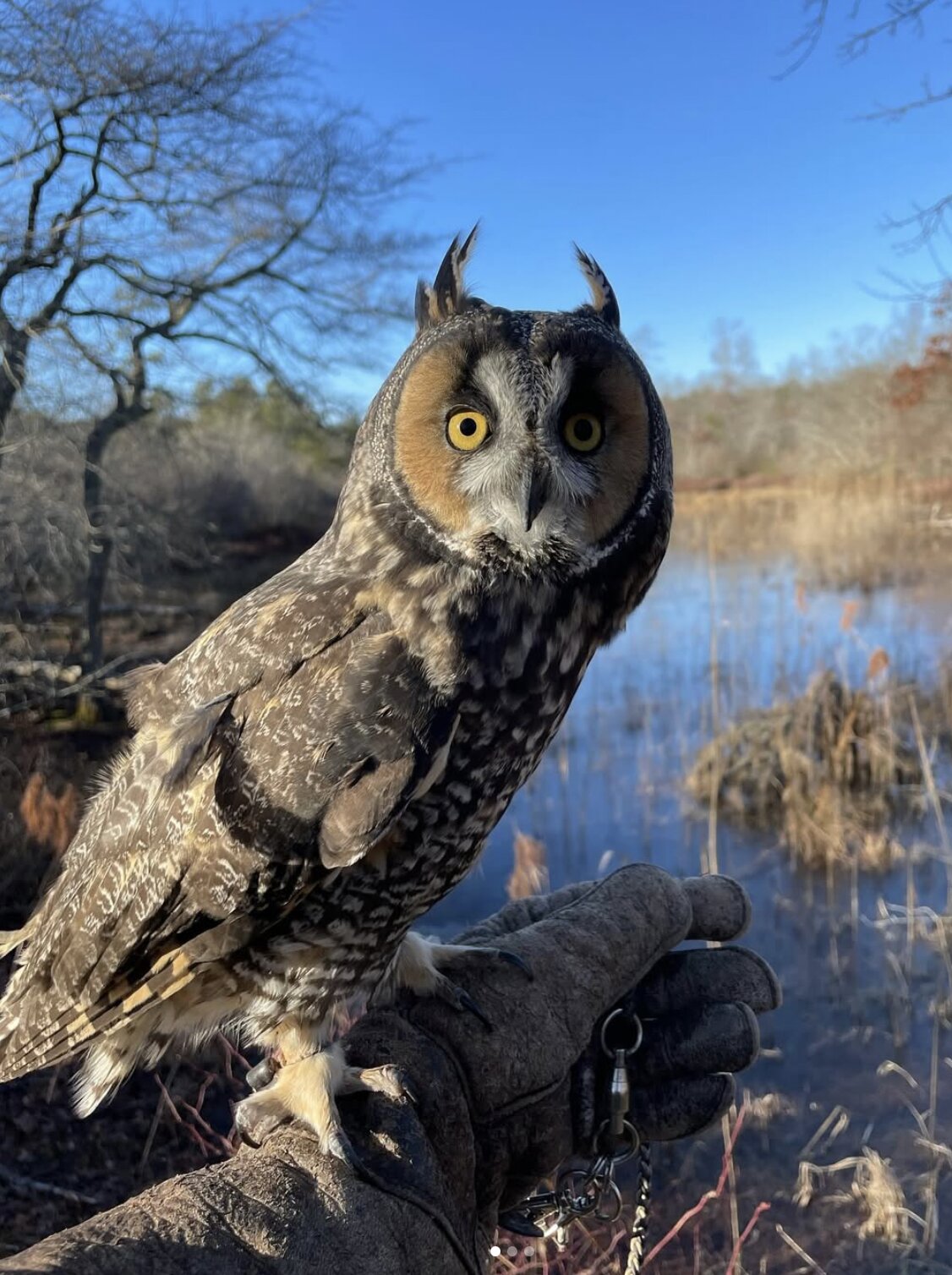
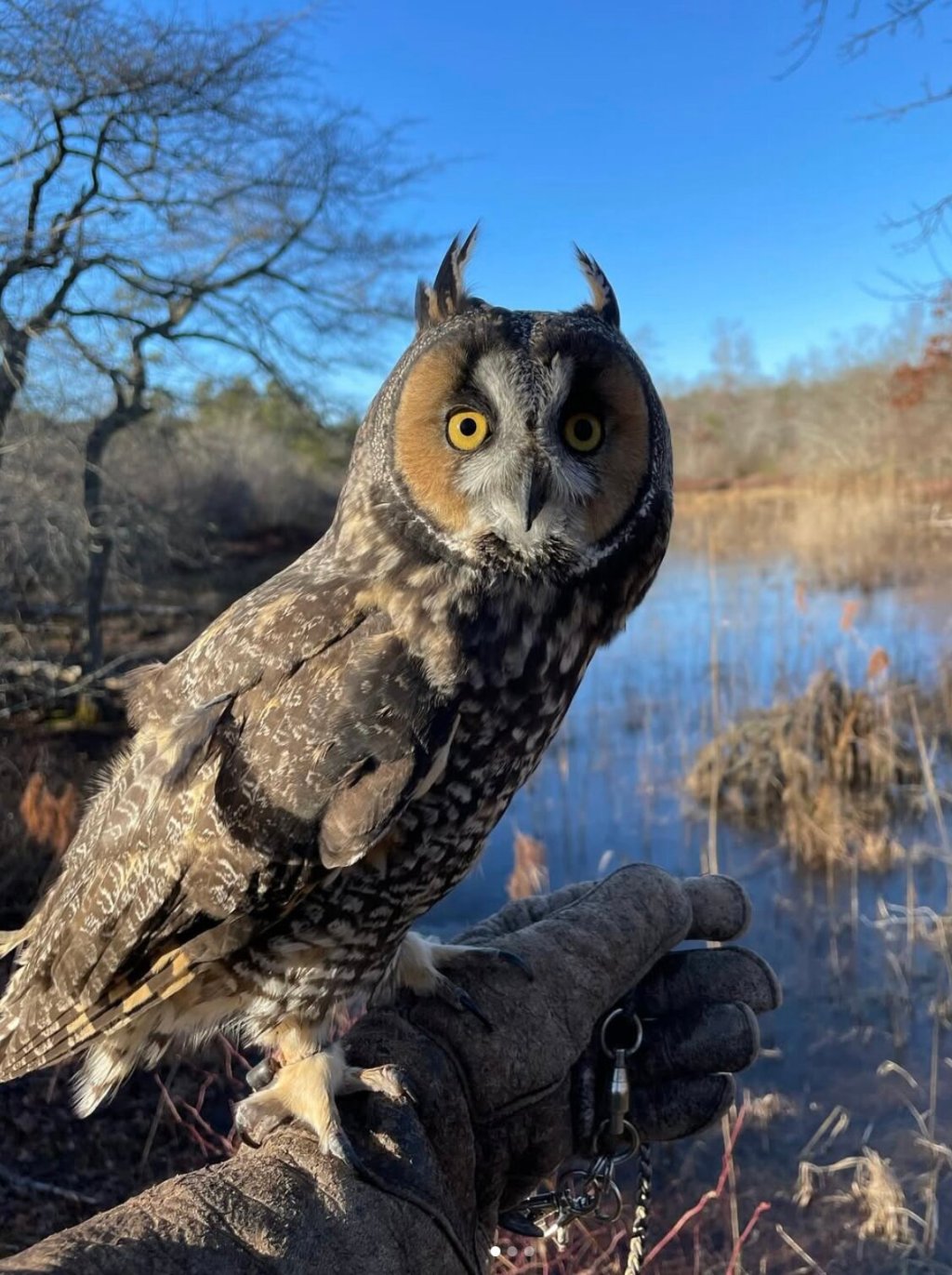
At the Evelyn Alexander Wildlife Rescue Center (EAWRC), one of their educational ambassadors, Leona, is helping visitors meet one of Long Island’s most rarely seen owls and better understand what her species is quietly losing. Leona is a long eared owl who was found by a hunter on February 8, 2018, grounded in the woods in Calverton with a badly fractured left wing. After she was brought to the EAWRC, hospital staff attempted to repair the injury, but the wing did not heal properly and amputation was ultimately necessary.
Kathleen Mulcahy, Executive Director of the EAWRC, explains that Leona’s name came from a simple misunderstanding, “Leona is a long eared owl. She’s actually named Leona because when she came in as a patient, we had just LEO in her cage. But then when we did some blood tests and found out she was a girl, we changed it to Leona.” Long eared owls are best known for the “long eared” tufts on their heads, yet Mulcahy explains those are not ears at all. The feather tufts help with camouflage, while their real ears are located on the sides of their heads.
Owls rely heavily on sound to locate prey, and “As all owls do, she actually can triangulate algebra to find her food,” Mulcahy continues, “Leona possess 3 eyelids: an upper lid for blinking; a lower lid for sleeping; and a transparent 3rd eyelid, known as the nicotating membrane, which is diagonally across the eye to protect it during flighting, hunting, and cleaning, allowing them to see while the lid is closed.”
Leona has quickly become a favorite at public programs because of her expressive personality. “Leona uses her eyelids to flirt like a mad woman. She just loves to flirt, and also loves to socialize at events and have staring contests with people. I would tell you she is my favorite, even though I’m not supposed to have favorites,” Mulcahy says. That personality has also helped support the EAWRC. Mulcahy adds, “Her flirting raises lots of money for us while she’s doing it. I try to get her to flirt with as many donors as possible. Everyone knows she is just a very special bird.”
When Leona arrived at the hospital, her injuries were extremely severe. “We tried to save her wing, but we just couldn’t, but thankfully at the time we were allowed to amputate her, and she was one of the last raptors that they allowed in New York State,” Mulcahy explains. Tammy Flanell, Education Manager of the EAWRC, adds, “To
amputate, we had to get special permission from the U.S. Fish and Wildlife Services because typically any amputation above the elbow of the wing is forbidden.”
Despite losing her wing, Leona adjusted to the ambassador life. “She’s been having a blast as an education animal, and she’s, I think, pretty happy,” Mulcahy says. She describes Leona as very trusting and very personal. When she does not like someone, she will puff out her feathers and click at them, too. Flanell explains that the transition was difficult at first, “Since she was being treated in the hospital for so long, she had just had such a bad experience adjusting, especially since she was an adult bird. Now, she’s enjoying her time with the educational program and has become a very social owl.”
In the wild, long eared owls nest in thick woods and dense stands of evergreens. They hunt by flying low over open meadows and farmland and are more strictly nocturnal than most owl species on Long Island. Flanell adds, “I had placed a camera in her habitat because I was curious, and she really moves around more at night than I ever imagined.” Because of this, the species is rarely seen. During the winter, groups of a dozen or more owls, called a parliament, can sometimes be found roosting together in trees. When disturbed, long eared owls raise their ear tufts, press their feathers tightly against their bodies, and freeze in place, resembling tree bark or a broken limb. This behavior once led the species to be known as the cat owl.
While Leona now spends her days helping educate the public, her species is facing increasing pressure in the wild. “The biggest threat to long eared owls is the loss of the open habitat they rely on for hunting as development and reforestation continue across the region,” Flanell explains. The use of rodenticides is also extremely harmful because long eared owls depend heavily on mice, voles, and rats for food, and poisoned rodents can directly impact the owls that eat them. Long eared owl populations are declining along the East Coast, and the species is considered endangered in some states.
Rehabilitators at the EAWRC explain that preserving open spaces is one of the most effective ways to help long eared owls. Avoiding pesticide and rodenticide use keeps toxins out of the food chain and protects not only owls, but many other wildlife species. For Leona, the loss of her wing changed the course of her life, and the EAWRC also urges hunters to remain extremely careful, as even a single mistake can have lifelong consequences for wildlife.
The Evelyn Alexander Wildlife Rescue Center is located at 228 West Montauk Highway, Hampton Bays. It can be reached at 631-728-4200, and animal emergencies can be reported at 631-728-WILD (9453). The EAWRC is open 9:00 A.M. to 5:00 P.M. seven days a week. Visit wildliferescuecenter.org for more information.
Vetted Hamptons Resources