Hampton Theatre Company’s I DO! I DO! Delivers a Nostalgic, Wise Take on Love & Marriage

In the 1960s and ’70s, my mother, Barbara, almost always had something spinning on the living room “hi-fi.” Barbara’s tastes were eclectic, at least to a point. There was jazz and classical, and plenty of Elvis and Johnny Cash and Joni Mitchell and The Beatles. More often than not, though, it was all about Broadway soundtracks.
This reviewer was raised on a heavy rotation of show tunes – particularly the great contemporary musicals of the day.
Shows like Funny Girl (1964), Fiddler on the Roof (1965), Cabaret (1966), 1776 (1969), Grease (1971) and A Chorus Line (1976) got lots of playing time in our Manhattan apartment, and later, our house in suburbia. I knew their scores by heart before I hit my teens.
Maybe she was profoundly interested in romantic relationships. Or maybe she just loved the music. But there were two soundtracks that my mother played more often than anything else. Both shows explored the intricacies of love and marriage, and both have been indelibly etched into my consciousness for the better part of five decades, long before I saw them on stage for the first time as revivals.
One was Stephen Sondheim’s Company (1970). From its eponymous opening number (“Bobby; Bobby; Bobby Baby; Bobby bubi; Robbie…”) to its finale, Sondheim’s erudite masterpiece still feels entirely modern and entirely relevant 56 years after its Broadway debut.
The other was, of course, I DO! I DO!. Though first staged on Broadway in 1966, only four years before Company, Tom Jones and Harvey Schmidt’s musical belongs to an entirely different era. So many of the classic numbers from the show are a hugely important part of my personal canon.
Given I DO! I DO!’s importance as a foundational piece of my musical architecture, I approached Hampton Theatre Company’s new production with a combination of giddy anticipation and caution.
If you’re staging this show, there are definitely some challenges:
For one thing, this is a two-person musical that takes place entirely in a bedroom (albeit one with a rotating bed). It features roles that were originated by Robert Preston and Mary Martin, two of the most incandescently gifted and charismatic stars in Broadway history – a pair of performers whose line readings and vocal pyrotechnics tend to stay with people. (When somebody says “Stella” you hear Brando in your head. When somebody says “nobody’s perfect” you hear Robert Preston and Mary Martin. At least I do.)
The show begins at the very end of the 19th century and spans 50 years in the life of a married couple with children. So, in addition to performing many demanding vocal numbers, often with complex harmonies and key changes, the players must age convincingly – not an easy task for young actors. Plus, the character of Agnes in particular is called on to whipsaw between a range of emotions and motivations. The conflicts, resolutions and transitions happen fast in Tom Jones’s script. In those scenes, an actor’s dramatic range is even more crucial than her vocal chops.
Would one of my favorite shows of all time hold up against the nostalgic hagiography of my memory? Would director Rosemary Cline and the HTC creative team give I DO! I DO! the kind of treatment it deserves? Would its stars meet the challenges of the material?
I’m happy to report that the answer to all my questions was a definitive ‘yes.’
Like marriage itself, this production is multi-layered, heartfelt, surprisingly adventurous and occasionally messy. It’s also old-school in the best possible way and utterly charming.
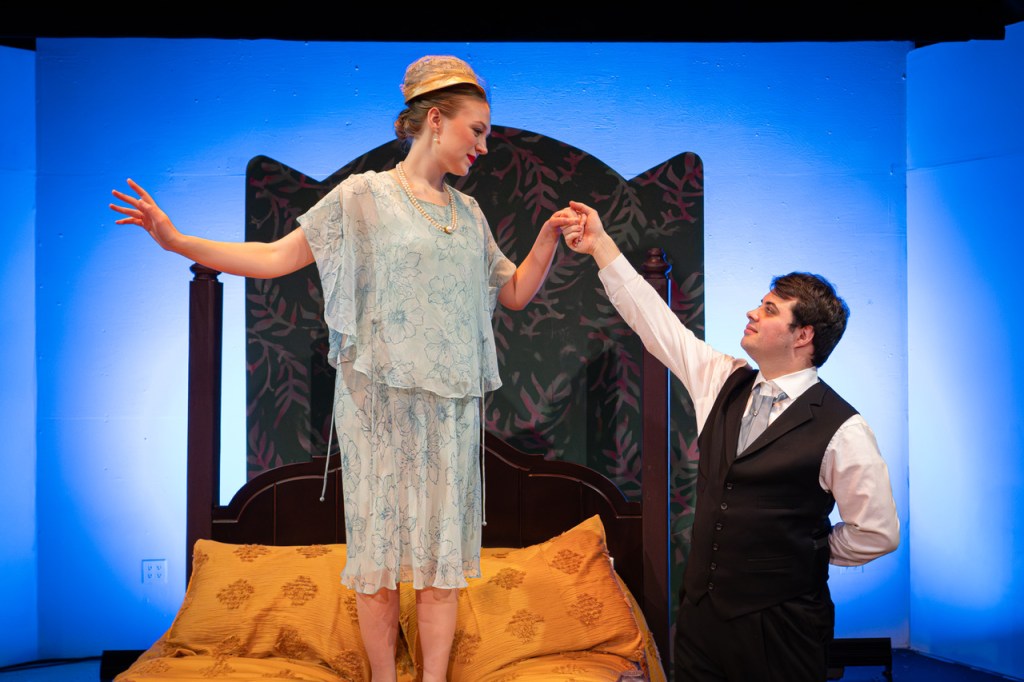
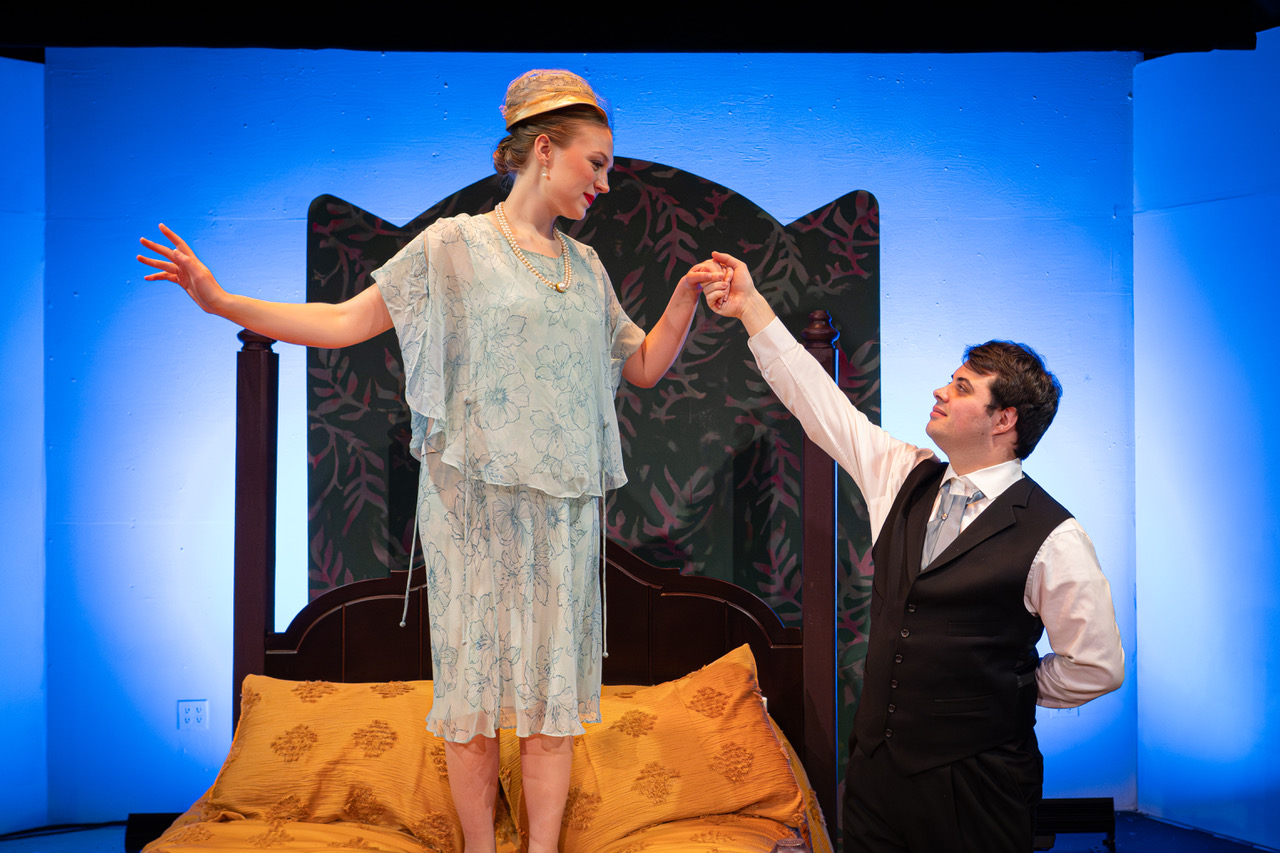
Both of the show’s young stars acquit themselves well. Nicholas Auletti, an East Quogue native, seems to have been built in a laboratory to play a guy from the late 19th century. Yes, he has a powerful and emotive singing voice that never stumbles over the tricky vocal sections. And despite an unfortunate stage moustache, his acting choices generally land well. But his vibe is the most uncanny thing about his performance. The guy’s character gets married in a top hat and tails, almost 100 years before anyone has heard of the internet, and he manages to feel completely of that era.
I’m not sure what kind of time-travel sorcery Auletti brought to his role, but it certainly pays dividends. Suspension of disbelief is a lot easier when your male lead absolutely inhabits the old-timey vibe that’s so crucial to the play.
Nailing the angst and complicated interior life of a father on his little girl’s wedding day, Auletti also delivers a pitch-perfect take on “My Daughter is Marrying an Idiot,” one of the show’s most entertaining – and wise – solo numbers,
A longtime HTC player and the current president of the theater’s board of directors, Rosemary Cline makes plenty of good decisions in only her second directorial outing for the company. But casting Auletti in the role of Michael is probably the single best choice she made.
Then there’s Agnes, as played by Savannah Jean Moore. Though it would be difficult for any scene partner to portray a character of a bygone era as convincingly as her co-star, Moore also manages to feel right at home in the 19th century. Later, she does some of her finest work as an older version of Agnes. She nails the tentativeness and caution and the physical discomforts of old age: the unsteady walk, the shakiness (and subtle vocal changes) that naturally occur through the years.
As a vocalist, Moore may be at her best when duetting with Auletti. In “Nobody’s Perfect,” arguably the show’s most well known number, she excels. She generally has lovely intonation, but in “Perfect,” her comedic timing is on full display as she parries with her co-star and gets in plenty of memorable vocal licks. “You chew in your sleep,” Agnes talk-sings at Michael midway through the number, her voice dripping with vitriol. It’s funny, of course – and everybody who has ever been in a long-term relationship knows exactly where she’s coming from.
The most demanding solo number in the show is probably “Flaming Agnes,” which imagines a hedonistic gay divorcee in middle age – a character Agnes sometimes longs to be, but will never actually become outside the confines of her imagination. Vocally, it’s a stops-out kind of number. When it crescendos, it requires abandon – and Moore leans into it. But to keep it from collapsing in on itself, the song also requires a degree of control, which she seems to know intuitively when to apply.
Agnes is a character who makes considered decisions. But in the next breath, she changes her mind. She’s leaving. She’s staying. She’s leaving again. Nope, she’s staying. Moore manages to bring the audience into Agnes’s process despite the abruptness – the scripted fickleness – of some of her most potent decisions.
Typical of men of the period, Auletti’s Mike isn’t big on evolving. He has his fling and thinks seriously about blowing up his marriage, but talks himself out of it when he realizes how much he has to lose. It’s as if he’s forced into his changes, motivated more by fear of losing Agnes than anything else. In those scenes, Auletti and Moore bring a complicated, world-weary chemistry to their roles.
Yes, there’s tenderness there – and genuine love. And the actors show the audience what that looks like, particularly in the final scene. But there’s also a long history of ambivalence and questionable behavior, a hardened patina of casual cruelty and unmet expectations. Moore and Auletti channel those marital realities in a performance that feels wise beyond their years.
In a nod to the commitment all good marriages need to survive, HTC is offering couples the opportunity to renew their vows on stage after the show while Moore and Auletti serve as witnesses. It’s a lovely little wrinkle, the brainchild of HTC’s general manager Terry Brennan, who officiates over the short ceremony. On the night I attended, two couples took HTC up on its invitation. And Brennan said that quite a few more couples have signed up to do the same at upcoming performances.
The couples renewing their vows on stage would probably agree with the sentiments expressed in this show’s signature number. Nobody’s perfect – it’s true. But this thoroughly enjoyable production reminds us that marriage isn’t about being perfect. It’s about trying our best to be good. And as the years melt away, being good should be good enough.
I DO! I DO! runs through March 29 at Quogue Community Hall.
Visit hamptontheatre.org.
Vetted Hamptons Resources