In the last half of the 19th century, the center of the art world was in Paris. Great works of art, now considered timeless, were created by Cezanne, Degas, Gauguin, Monet and others to be celebrated in that city and elsewhere in Europe at that time.
However, a sensational Armory Art Show in New York City held at the turn of the century introduced avant-garde work that caused the center of the art world to shift to America. Capitalizing on that, a grand wooden art gallery building was constructed on Jobs Lane in Southampton where, in the summertime, artists mingled with the wealthy New York City social set that had begun summering in the Hamptons after the railroad extended its tracks to Southampton.
This building, the Parrish Art Museum, was not originally built for the great artists. Named for Samuel Parrish, a wealthy patron, it became home for his art collection but also for the work being produced by the wives of the wealthy who were painting outdoors in the fields of Shinnecock under the direction of William Merritt Chase, a prominent American artist who had come out for the summer to found an art school featuring plein air painting.
The art school lasted 12 summers. There’s a group of Victorian homes on Hill Street called the Art Village built for the school, where students and teachers lived and worked for a time.
As the years went by, the works of some of the great American artists who migrated to the Hamptons during the first half of the 20th century were shown at the Parrish Art Museum. But by 1970 the work of Pollock, de Kooning, Motherwell, Rothko, Frankenthaler, Porter, Rivers and Warhol, painting in the New York School or abstract expressionist style, among others, were selling for millions and were not being displayed anymore but instead were being left in a locked basement. Wondering about this, as editor of Dan’s Papers at the time, I inquired and was told there was no way to show them because there was no way to secure them. No alarm system, no proper locks. And at least above the basement, no proper climate control. The Parrish was a summer museum.
Because Dan’s Papers was 20 years old and had become quite popular by then, I was taken down to the basement to see the paintings, now all in racks there. It was obvious that these works, which were removed from the racks so I could see them, needed to be shown. They were staggeringly beautiful and inspiring. There just had to be a new building.
Fundraising in the early 21st century quietly brought 50 million dollars to fund the project.
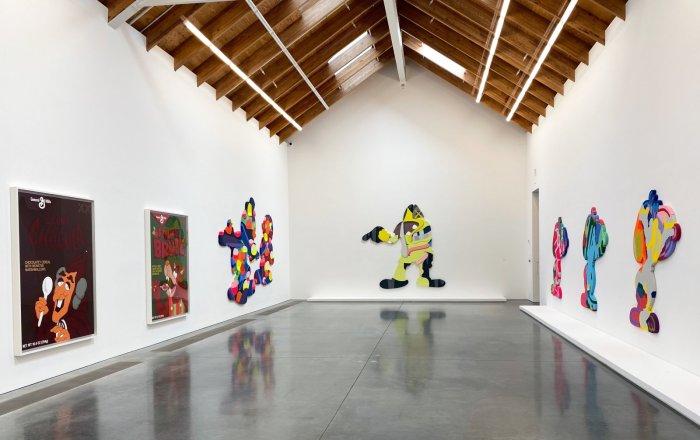
KAWS paintings on view at the Parrish Art Museum in Water Mill, Photo: Oliver Peterson
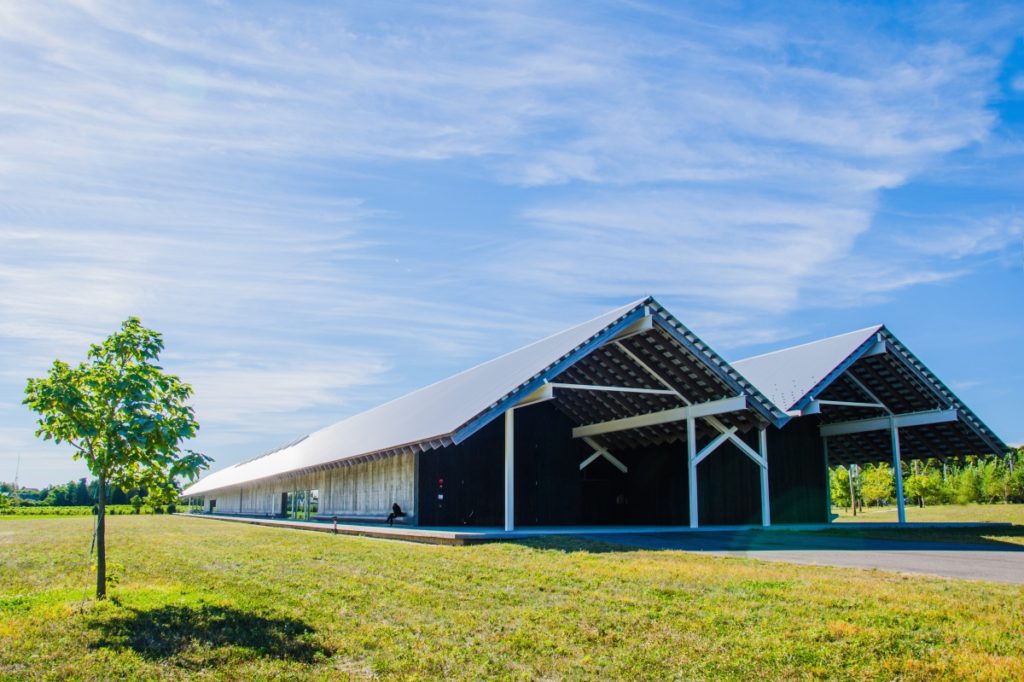
Fourteen acres of property were purchased on the Montauk Highway just west of Water Mill. A Swiss architect had proposed it be a series of buildings each a replica of the studio of one of the great American painters of the 20th century who’d lived and worked here. But bidding for the project estimated the cost at $90 million. It was too much. A newer plan, submitted by architects Herzog and de Meuron, would be just one building that looked something like a giant potato barn packing plant. It was accepted, built and then opened in 2012 at a cost of about $50 million. It’s far better than what the earlier plan might have been.
Great works are shown in four major galleries inside. Plein air too. There’s also a lecture hall and performance space and a snack bar. It’s a major national art gallery now. Worthy of the artists it shows. Experiencing this takes your breath away.
Have a East End real estate story? Want to share? Text us at 516-527-3566. We’ll call you back, and then write it up for this weekly column. –Dan
Vetted Hamptons Resources
Hamptons Classified
Access our trusted network of local professionals and browse employment opportunities in the Hamptons.

 By Dan Rattiner