
Actor Josh Pais Teaches Readers How to 'Lose Your Mind'


A Sag Harbor resident for 16 years, Josh Pais’s name may sound unfamiliar, but anyone who watches television or movies will immediately recognize his face from a long list of productions, including Joker, 1990’s Teenage Mutant Ninja Turtles (he played Raphael), Rounders, Adventureland, Ray Donovan, Power Book III: Raising Kanan, and well over 100 other films, shows and plays. Now’s he’s added author to his growing list of accolades, with a book that demonstrates how he managed to achieve such a brilliant acting career, despite early battles with low self-confidence, fear and anxiety.
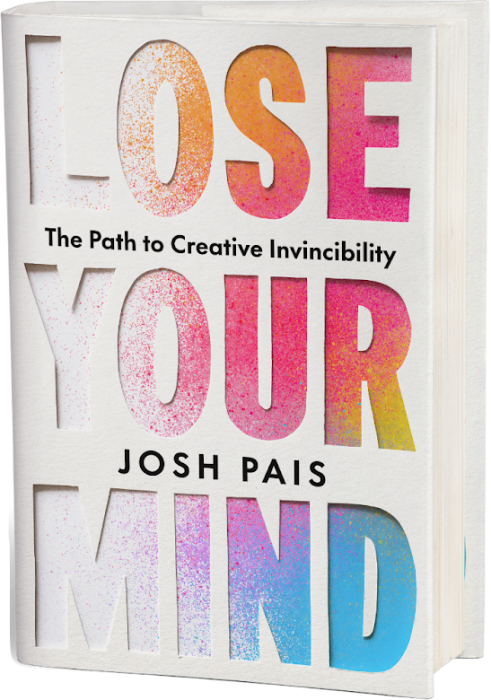
Recently published on September 30, Pais’s new book, Lose Your Mind: The Path to Creative Invincibility, teaches readers how to be spontaneous, in the moment and not ruled by a false notion that we need to control our emotions or master our feelings. Instead, Pais uses his “Committed Impulse” method to accept all feelings and emotions and remain present to simply do the thing one wants to do, without all the noise and struggle. It works so well, that for years he’s taught the method for successfully staying calm under pressure and accepting our entire experience as essential to young actors, NAVY Seals, artists, Fortune 500 executives and others from all walks of life.
“I think the greatest myth of our time is this notion that there are good sensations and bad sensations, good emotions and bad emotions, and we have to remember that it is built into our DNA. It is built into our fabric to feel every emotion,” Pais explains during a recent phone conversation. “What I teach people, instead of how to manage what they’re feeling, how to alter what they’re feeling, is how to increase your tolerance for everything that you’re feeling, so that you can stay present and productive no matter what you’re feeling.”
The actor credits his father, Abraham Pais — a Holocaust survivor and world-renowned theoretical physicist who worked with Albert Einstein — as the original inspiration for this outlook when he was a child growing up in Lower Manhattan. In the book, Pais recalls asking his father to explain his job. Cryptically, at first, the man asked his son to look at the table, and next at his knee. “Well, Joshua, the smallest part of that table, and the smallest part of your knee are THE SAME THING. Atoms,” his father said, adding, “That’s what I explore. The building blocks of the uni-verse,” before heading out the door.
The lesson stuck and, many years later, informed an idea: Feelings and emotions must also be made of the same building blocks.
“When I started auditioning and having so much fear and so much nervousness, I thought that I would have to give it up. But then, when I reflected on that conversation with my dad, I figured, well, emotions are happening in my body, so they must somehow be connected to atoms.”
With this in mind, Pais stopped judging thoughts as good or bad. As a result, his entire experience became creative fuel, he began landing roles, and his career flourished.
“After going to acting school, I went on this two-year journey experimenting with how I could make spontaneity something that I could count on, and I trained with people from all over the world and all kinds of different disciplines, just exploring how to access spontaneity,” Pais explains. “And as a result of that, people just started asking me to teach… And then NYU asked me to start teaching.”
While he initially only taught acting, Pais’s scope broadened as people from other fields came knocking. For example, he helped a high-powered lawyer, who had begun losing cases, to accept all aspects of herself, and to stop suppressing her feminine side in the courtroom. “She wanted to hide anything vulnerable, anything kind,” Pais recalls. “I really worked with her to allow herself to feel everything, even when she was in the midst of a trial. And she found that allowing vulnerability made her not only win more cases, but also in her closing arguments with the jury, she noticed that all of a sudden, the jury was wide awake and listening to her,” he says, adding, “Everybody has an audience in one form or another, and we’re diminishing the possibility of an audience connecting to us, because if we’re trying to disconnect from ourselves, it makes it really hard for somebody else to connect to us. And so, I train people how to increase their tolerance for everything that their body is feeling, and that becomes a superpower.”
Now, the secrets to that superpower are laid out in Pais’s book, which is an accessible read loaded with valuable information and engaging stories from his life and career.
“And as soon as you suppress anything in the body, you go up into your head and listen to how you suck. So this is about fully learning how to live in a human body, so that you’re not dominated by limitations that the mind is dropping down,” Pais says, also noting, “I’ve been teaching for decades, and this book throws away the notion that there’s anything wrong with what you’re feeling. As soon as people can step into that and honor what they’re feeling, life becomes amazing.”
Visit committedimpulse.com to learn more about Josh Pais, Lose Your Mind: The Path to Creative Invincibility and his Committed Impulse training.
Vetted Hamptons Resources