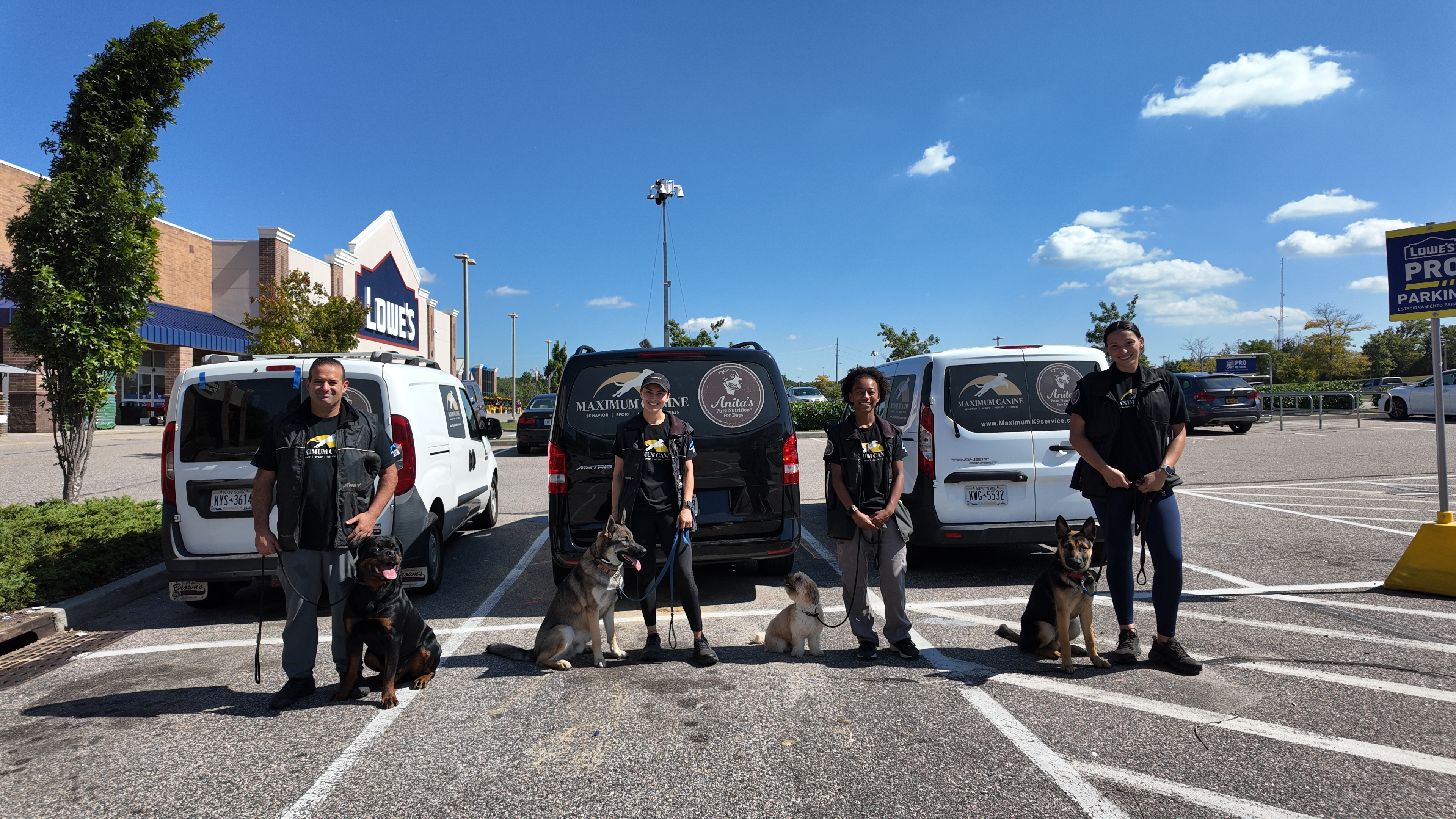
Maximum Canine is a full-service dog facility with a main location in Deer Park and secondary location in Riverhead.
Dogs are members of the family, and should be treated as such. At Maximum Canine, that belief shapes everything from training sessions to nutrition plans.
Founded in 2010, the Long Island-based company approaches dog care as a lifestyle rather than a one-time service. With a primary facility in Deer Park and a satellite location at The Hydrant in Riverhead, Maximum Canine centers its work on four pillars: behavior, sport, health and fitness. The goal, founder and president Joe Secreti said, is to meet a dog’s physical and mental needs while educating owners along the way.
Dan’s Papers spoke to Secreti about Maximum Canine – who they are, and what they do.
Tell us all about Maximum Canine – who are you?
Maximum Canine is a full-service dog facility. One of our locations is in Deer Park, and we also have a satellite location at The Hydrant in Riverhead. We concentrate on four main pillars: behavior, sport, health, and fitness. When I say sport, I mean fulfillment-type programs.
We’re not just training obedience, although we do do that. We’re looking at the full diversification of the animal and building a diversified system. That means making sure there’s fulfillment, exercise, clear communication between the dog and the owner, and proper nutrition. It’s similar to building a diversified lifestyle for a person.
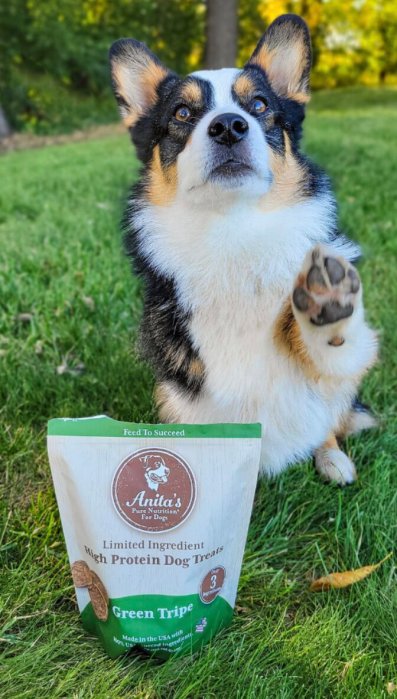
We also offer retail and nutrition under our sister company, Anita’s Pure Nutrition for Dogs. That’s a raw, balanced diet, along with natural treats, chews, and supplements. We provide education, community, services to train both dogs and people, and continued programming. For many clients, it’s a lifelong engagement. We offer seminars, webinars, and fulfillment programs. It’s not a set-it-and-forget-it model — it’s more of a lifestyle.
How did Maximum Canine come to be?
How we got here is important. This is the outcome of my life in the dog world. I’m 47, and I’ve been involved since I was very young. My grandparents bred German Shepherds, so I grew up in that environment. I worked in a dog boarding facility at 12 years old. I rescued my first dog at seven and rehabilitated it. At a young age, I started this addiction to transform dogs, not realizing it was going to be a job.
That’s where this addiction to transforming dogs from A to Z began. I didn’t realize it would become a career — it started as a hobby. I eventually got into competitive dog sports, competing nationally and internationally. I showed Rottweilers overseas and in the U.S.
Later, I worked as a bomb dog and drug dog handler, training and certifying dogs, and worked under the Waterfront Commission in New York City. My experience became well-rounded through working dogs, active dogs, and eventually rescue dogs. I worked with shelters and fosters, and over time, my résumé built itself after doing things as a hobby.
I went to college and had other jobs, but I always trained dogs on the side. Around 2010, I owned another company that wasn’t doing well, while dog training kept growing. I shifted my focus full-time and built the business from a small operation into what it is today — 25 employees, two locations, and clients across Long Island, Manhattan, Connecticut, and New Jersey. We handle everything from behavior modification to general obedience to working dog training.
Tell us more about how your goals grew.
It started with that first rescue dog when I was seven. As the business grew, I realized I wanted to do more with shelter dogs. The issue was scalability. I could help one dog, but that wasn’t enough.
So we developed a rescue shelter network. We work with local shelters and fosters across Long Island. We volunteer our time, provide education and classes, and meet monthly at our training facility. We also work with municipalities like Southampton, Hempstead, and Smithtown. We share ideas and then go into shelters weekly to work directly with volunteers.
The goal is to teach handlers to be better with dogs, improving the dogs’ experience in shelters and increasing the likelihood of adoption — and successful long-term adoption. It’s not about taking one dog and training it; it’s about educating people so they can help many dogs.
We’re also looking to expand into Nassau County.
Dan’s Papers has featured The Hydrant before. How did this collaboration come to be?
Years ago, when The Hydrant was for sale, I considered purchasing it but didn’t have the resources. I reached out to the eventual buyers and said I’d love a footprint on the East End. Years later, they contacted me.
We now train out of their facility. We work with their dogs and with clients across the East End. Some dogs train there; others train at home or at our Deer Park location for board-and-train programs. It’s a strong partnership with aligned values.
You emphasize meeting dogs’ physical and mental needs. What does that look like in practice?
Every dog is an individual puzzle. Genetics play a major role. A German Shepherd is genetically wired differently than an English Bulldog. If a breed is designed to herd or retrieve, we need to account for that instinct.
Many households try to fit all breeds into the same mold. That’s where problems arise — reactivity, prey drive, defensive behavior, excessive energy. We evaluate what the dog naturally desires and build a fulfillment program around that.
For example, with a Labrador, we may teach structured retrieving — throwing a ball into water or brush — and tie obedience into that game. The dog learns that obedience leads to access to the game. We use varied reinforcement: food, play, emotion, praise.
We also consider the household. If the owners are older, we won’t suggest unrealistic physical routines. Fulfillment must be achievable.
Anita’s Pure Nutrition is a big part of what you guys do at Maximum Canine and The Hydrant. How did that come about?
Anita’s is named after my grandmother. She was instrumental in teaching me how to communicate with and care for dogs. Growing up, feeding dogs meant real food. As I entered the broader dog world, I moved toward commercial kibble, influenced by marketing.
In the early 1990s, one of my Rottweilers became very sick with allergies and hot spots. I transitioned to a raw diet and saw dramatic improvements. At that time, raw feeding was rare and mostly used by working dog communities.
I began developing my own recipes. Demand grew, and eventually I partnered with a manufacturer. A nutritionist formulated it, and it’s third-party tested. We scaled responsibly instead of trying to build a manufacturing plant ourselves.
Now we supply customers, retailers, and sell online.
Anita’s Pure Nutrition offers human-grade food made in a USDA-inspected facility.Maximum Canine
A lot of people are feeding their dogs whole foods or even raw diets nowadays. It’s almost as if you got ahead of a trend.
Yes. In the 1990s, most veterinarians opposed raw feeding. Today, many refer clients to us. It took decades.
The same pattern happened with electric treadmills. I partnered with Dog Runner, a European company. Europe has historically been ahead in working dog development.
I used flat mills first, then saw the advantages of electric treadmills. We began importing them and educating clients. Initially there was resistance, but once people understand that dogs are taught to value the treadmill — similar to leash training — they see the benefit.
Now we distribute across the U.S., including to military units, police departments, veterinarians for rehab, training facilities, and pet owners with high-drive dogs. Exercise isn’t just about tiring a dog; it’s about fulfillment and teamwork.
In the simplest terms, how would you describe Maximum Canine?
Speaker 1: We’re a lifestyle brand built around four pillars: behavior, sport, health, and fitness. We’re a full-service educational facility. It’s not about “How many lessons does my dog need?” It’s about ongoing development.
We provide a network, free programs, webinars, fulfillment opportunities, products, and services. It’s a long-term approach.
What else about Maximum Canine can you share?
The shelter network is a major focus. It’s helping bring typically segregated shelters together to share knowledge and improve outcomes.
We’re also building a sport membership program where clients can access structured fulfillment activities at an affordable rate — almost like an in-house gym for dogs.
Maximum Canine’s main location is at 1011 Grand Blvd, Deer Park and can be reached at contact@maximumk9service.com or 631-940-1511. It has a satellite facility at The Hydrant Hotel, 845 Raynor Ave, Riverhead, which can be reached at 631-601-2835.
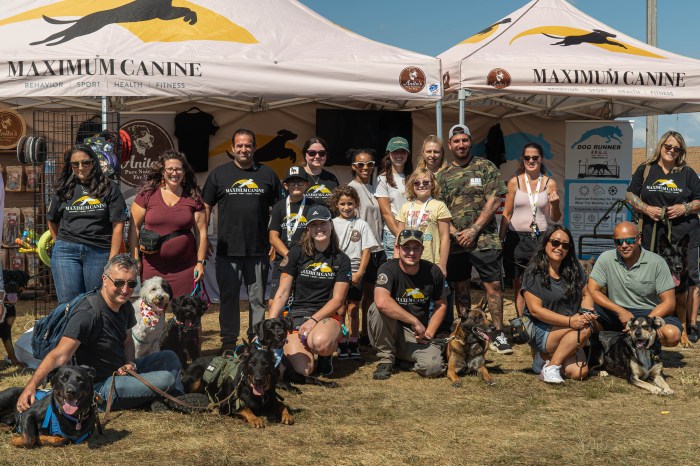
The Maximum Canine team at a Tanner Park expo.Maximum Canine
Vetted Hamptons Resources
Hamptons Classified
Access our trusted network of local professionals and browse employment opportunities in the Hamptons.