F-14s in Iran and the East End Connection
 By Dan Rattiner
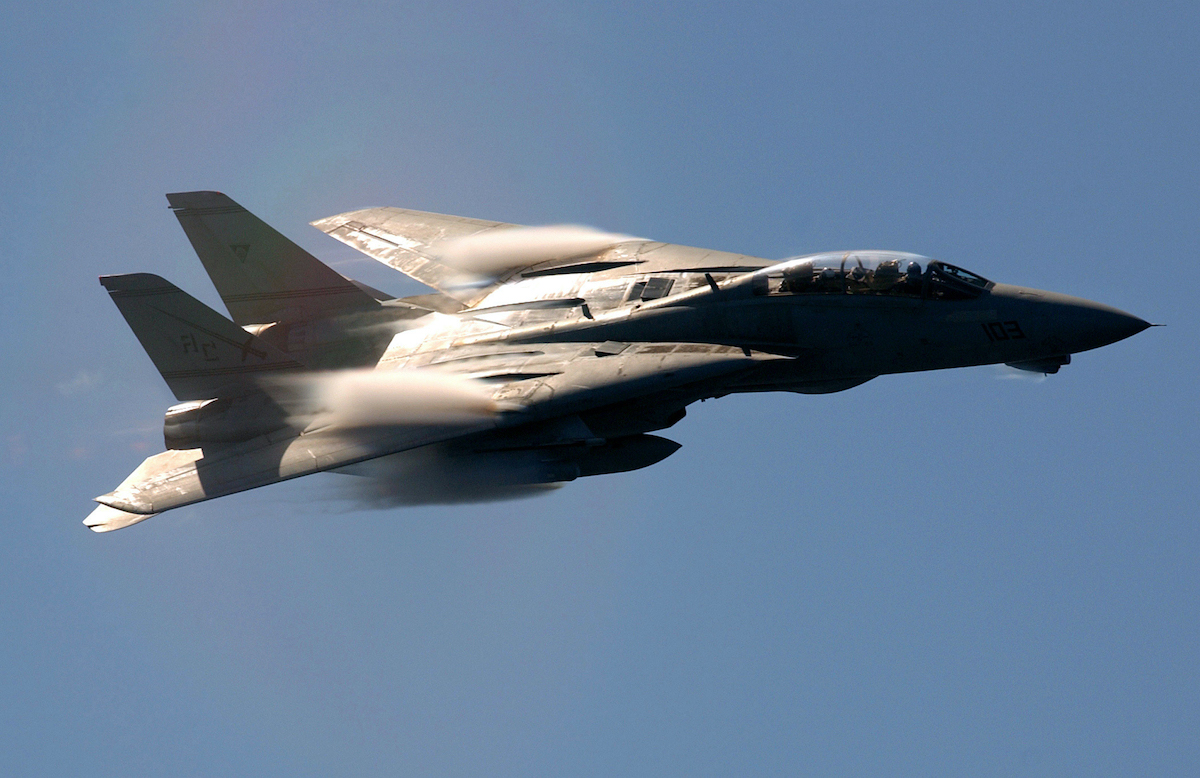
The worst thing I can think about Long Island as far as the War in Iran is concerned is that Long Island might have done something to start it. Last week, the Israeli Air Force reported they had destroyed three powerful Iranian F-14 Made in America fighter planes on the tarmac at a military airport in Iran. That is what brought this to my attention.
The F-14 was produced on Long Island. When Grumman first rolled this plane off the assembly line in 1970 in Bethpage, it was introduced as the fastest, most powerful and most advanced fighter in the world. It could engage 24 enemy aircraft over the horizon and send missiles at six of them simultaneously. Its avionics and computer programs were so advanced they were kept top secret for 20 years, until the 1990s. F-14s could fly at Mach 2. Want to see one in action? Watch Tom Cruise fly one in the film Top Gun.
Back in those years, as a teenager, I got an up-close and personal view of these fighter jets as well. The F-14 was tested in the skies over the Hamptons. Grumman had a private airport in Riverhead. It’s still there, though it’s an industrial park today. But back then, having driven by Grumman’s airport with its “Keep Out” signs and barbed-wire fencing, I knew what was happening when I saw them thunder through the sky, doing rolls, steep climbs, and dives over the ocean. They were a testament to the might of the American military.
You might think a fighter plane such as this would never get shared, even to our closest allies. But you would be wrong. Only a few years after the first F-14 was built in 1969, a contract was signed by our government to sell 80 of them to Iran. No country, before or since, has ever been allowed this courtesy. It was just us and Iran. And Iran, at that time a backward nation run by a king, the Shah of Iran, took his country’s new role as America’s partner very seriously.
No one could have imagined, in those heady days of the Cold War, that several years later, a revolution would overthrow the Shah and send him packing. But it did. Soon, there was a new regime, run by an Ayatollah, who would denounce the United States, become best friends with the Soviets, hold American diplomats hostage, and have his people shout, “Death to America,” as they examined this new prized weapon. Their foreign policy, emboldened, charged forward as never before. And so here we are today, half a century later, with aging F-14s still flying, challenging America.
This whole upside-down situation began in 1967, when the United States was surprised to see the new Russian MIG-25 flown at at an air show at Moscow Domodedovo Airport. It flew faster, higher and more nimbly than anything we had. So President Richard Nixon tasked Grumman to design and build one that could beat it.
Grumman, based in Bethpage here on Long Island, had been building fighter jets for decades. In 1969, designed and built the rover the astronauts used to drive around on the Moon. They’d built trainer aircraft. Surveillance aircraft and jet planes for the Navy.
Long Island, where all this was happening, was a center for scientific achievement. Scientists at the Brookhaven National Laboratory had built the world’s largest cyclotron where molecules could be banged together until they split. Early radar systems were in Montauk, Atlas missiles in the ground at the Westhampton Airport, Marconi communication towers in Napeague. Albert Einstein spent his summers on the North Fork. Thomas Edison did work in Quogue and Riverhead. Nikola Tesla had a tower in Shoreham and torpedoes were tested in Fort Pond Bay.
Grumman was asked to build more than 700 F-14s, a job that soon turned out to be costing far more than anyone had thought. Grumman began talking of bankruptcy and an abandonment of the F-14 project. As a result, our government brokered a sale of 80 F-14s to our friends in Iran to stabilize the Middle East. Iran would pay $2 billion for this prize. Putting the project back on schedule.
In 1979, however, with 79 of the 80 F-14s now in Iran, the revolution occurred, the Shah fled to America, the fundamentalists took over, American diplomats were seized and the Iranian pilots trained at bases in America to fly the F-14 arrested, jailed and killed. Iranian pilots loyal to the Ayatollah were introduced to the F-14s, but they found spare parts and training manuals gone. A new way would have to take place to get these planes to fly.
Thus came a two-way deal with the devil. The Ayatollah needed spare parts from Grumman. But President Jimmy Carter, unable to free the hostages, had halted all trade with Iran. But then Ronald Reagan became president. He secretly offered spare F-14 parts for the hostages. The Ayatollah agreed to it. And the hostages came home. With that, Iran became a big power in the Middle East. Rockets, drones, tanks and murder followed. Iran was now a highly armed enemy.
In the years that followed, F-14s sometimes fought enemy planes. In every engagement the F-14s shot down their opponents. They are undefeated. (American F-14s have never faced Iranian F-14s, though.)
Around 1995, I became friends with John Darden, a salesman working at Dan’s Papers. We played golf together from time to time. And on one of those occasions he told me he’d earlier worked as an engineer for Grumman.
He was in Iran, helping Iran, when the Shah fled. The Grumman employees also fled, one step ahead of the Ayatollah, carrying instruction manuals. They also saw to shipping the spare parts home. But they did have to leave the F-14s behind.
For some reason, I thought it was only a few. Maybe three. I never did ask John the exact number. But now, with AI research, I know.
What I did ask John was this:
“Were there golf courses where Grumman executives could play?”
“Yes, there were,” he said. “But they were all just sand with flags stuck in them.”
No big deal.
Vetted Hamptons Resources