Father Charles McCarron, Rector of St. Mary's Episcopal Church of Shelter Island
 By Todd Shapiro
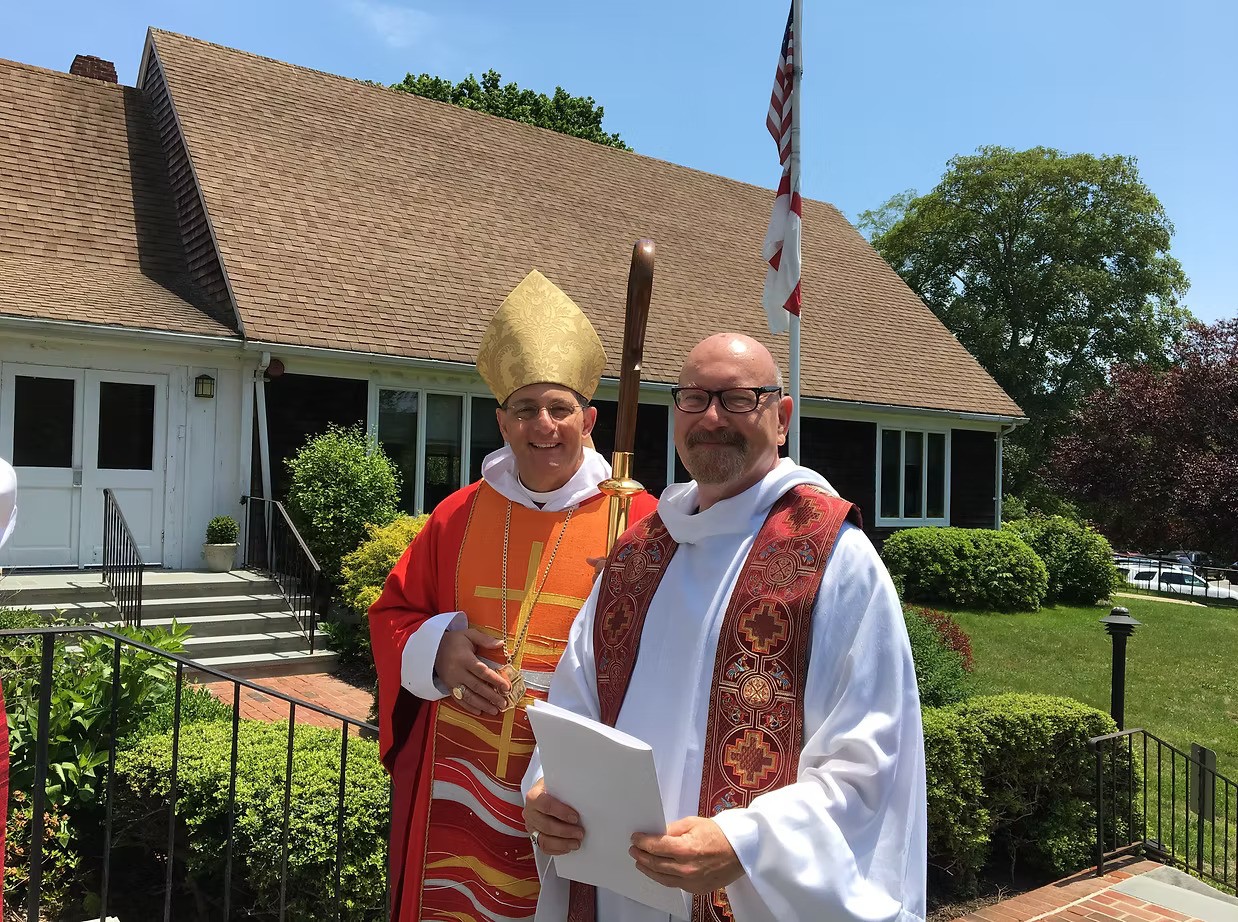
Canon Charles McCarron, rector of St. Mary’s Episcopal Church on Shelter Island, has a great appreciation for history, which is nice considering he pastors a church that was first built in 1871 and rebuilt in 1897.
“There was a fire and the original church completely burned down,” McCarron explains. “There were two big estates on Shelter Island. The Nicolls family’s was one of them. Samuel Nicolls was the town supervisor at the time. His beloved Irish butler died. Because he was a Roman Catholic none of the town cemeteries would bury him.”In response, Nicolls bought some land and built the new Episcopalian church. The Nicolls estate eventually became Mashomack Nature Preserve, a 2,039-acre coastal nature reserve established in 1980.
“The family graveyard is still in the woods of the preserve,” says McCarron of the preserve at 79 S. Ferry Rd. that includes marshes, forests and creeks.
The church has its own history. In addition to windows designed by Louis Comfort Tiffany, they also have windows designed by stained glass competitor Walter Cole Brigham, whose family still worships at St. Mary’s. His work at the church, which can also be found at the Brooklyn Museum, is made of local shells and stones from Shelter Island beaches.
“Churches were always the center of community life at that time, and they doubled for meeting houses,” McCarron explains. “St. Mary’s was built to be exclusively used as a church for worship in the Neo-Gothic style, which was unusual at the time.”
And, while there is a lot of history to the church, McCarron, who is of Scottish descent but was born and raised in the Bronx, is looking forward. He understands that the church of today is different than the church of five or 10 years ago.
“I’ve been ordained for forty years, and this is the first time I have been a full-time parish priest,” explains McCarron, who spent much of his ministry career in social service and community service on Long Island. He was the first person on either side of his family to attend college. “Being on an island provides a certain culture. You have recent people, summer and second-home people and year-round people. We do have families whose relationship to the church stretches back one hundred years or more.”
He explained that churches that are off island can draw from a broader population and even have an easier time sharing responsibilities and interacting with other churches. Those wanting to do some sort of exchange or joint program with St. Mary’s having to contend with that ferry ride.
“If you want just a simple joint Bible study, you have to take into consideration the ferry ride and even the schedule of the ferry not to mention the fare,” McCarron says with a laugh. “If you’re off island, you can pull from the north or South forks.
He added that, realistically, Shelter Island probably has about 2,000 people year-round. And most on the island are Roman Catholic or Presbyterian, with Roman Catholic dominating.
“One of the things we have to contend with is how to open our doors to people who are looking for a religious connection but who are turned off by conventional religion, or who have no experience with conventional religion,” says McCarron, who was received into the Episcopal Church from the Roman Catholic Church as a priest in 2002 after receiving a master’s in sacred theology from the General Seminary of the Episcopal Church. “It is not like the 1950s, when you didn’t have to do much to fill the pews of the church. Everybody went to church back then. You could always presume everyone you spoke to had some experience of God and the church. Today, some people have more of a cultural connection with eggs Benedict and mimosas rather than church.”
McCarron says that it is incumbent upon members of the clergy to find ways to reach out to those who find it unusual to attend church.
“You have to look for other ways for people to open up,” says McCarron, who has been a Diocesan canon and has served as executive director of Episcopal Community Services Long Island for the past 10 years. During that time, he also served as vicar of the churches of St. Lawrence of Canterbury in Dix Hills and Resurrection in Richmond Hill. “Since Covid, churches have gotten smaller. We have historically always been a small church. We’re basically a little country church with a lot of history.”
McCarron explains that small things can make a big difference to a congregation of their size.
“You want to be able to bring new people in without driving away those who are used to institutional religion,” explains McCarron, who at one time was diocesan missioner for the Great Neck Episcopal Ministries, uniting three congregations, two English-speaking and one Korean. “My style is more informal. We host a lot of twelve-step meetings and wondered how we could encourage them to attend prayer service, which was being held. We finally decided to just leave the door open, and people started to come in. Something as simple as that. We didn’t need to overthink it. People are coming because they want to meet, to have a relationship with God. The question for us is ‘How do we make it easy for them?’ ”
Another way they’re connecting is through a prayer wall where people can put in their prayer requests. It is on the way to the church.
“The wall has holes in it where you can stick your prayer request,” McCarron explains. “We get about ten or so requests a week. What we’re trying to do is remove as many barriers as possible. Sometimes it really is as simple as leaving a light on.”
“There are multiple congregations on Shelter Island, Episcopal, Presbyterian and Roman Catholic,” McCarron said. “We cooperate as much as we can. We support a common Vacation Bible Study in the summers, staffed by the three congregations and held at St. Mary’s. We each have different cultures and different approaches to our congregations. I think unity in diversity is the path to take.”
As a member of the Third Order of the Society of St. Francis, he taught the friars at Little Portion Friary and conducted retreats in Franciscan Spirituality, methods of prayer and vestry retreats.
“We’re coming up on the summer, when thousands more young people will be on Shelter Island,” adds McCarron, who has a Master of Arts in historical research in Franciscan Studies from the Franciscan Institute of St. Bonaventure’s University, as well as graduate degrees in theology and law. “We offer a ‘Taize’ service, which is a simple form of chanting in multiple languages. It has no connection to us or any other church. It is another way we are opening the doors a little more.”
For more information about services and other activities, visit stmarysshelterisland.org or call 631-749-0770. The church is at 26 St. Mary’s Road.
Todd Shapiro is an award-winning publicist and associate publisher of Dan’s Papers.
Vetted Hamptons Resources