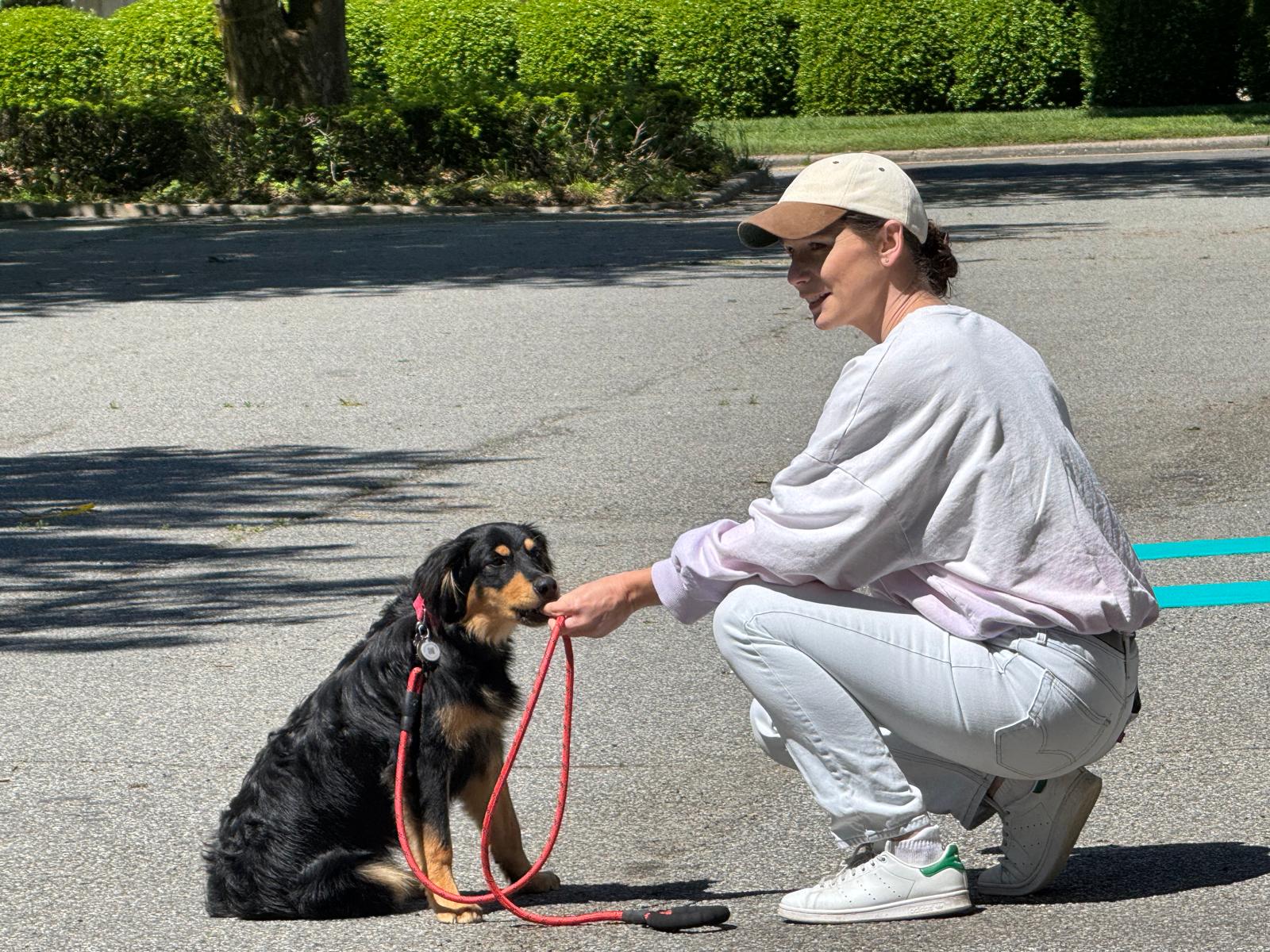
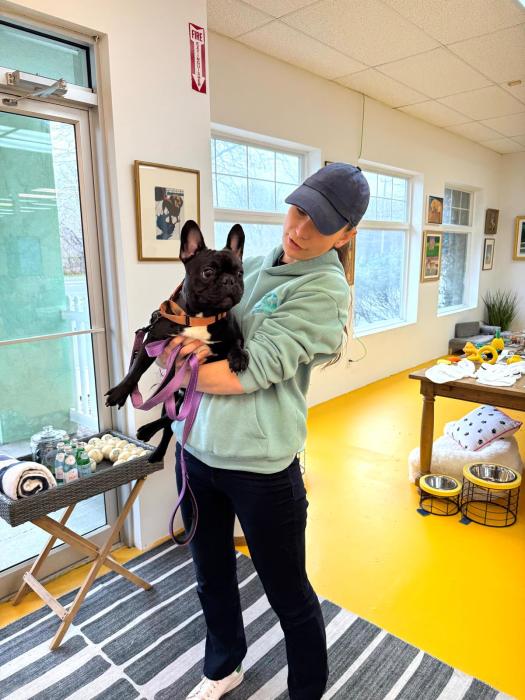
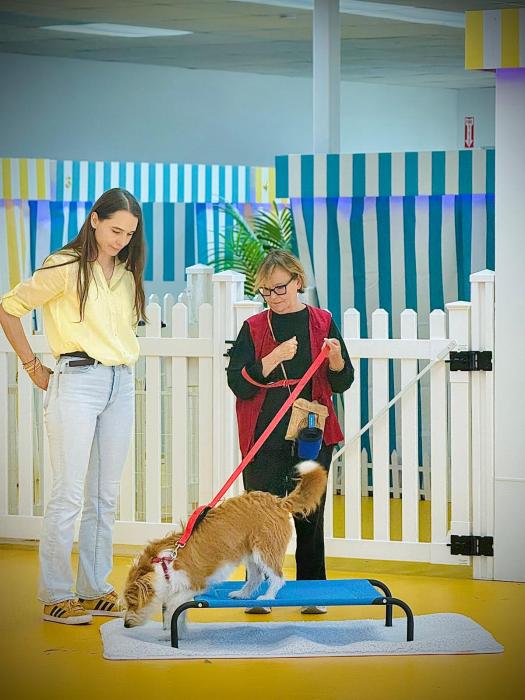
At Southampton Dog, experienced trainers will uniquely tailor you and your pet’s needs.
At Southampton Dog, the core belief is simple; nothing short of the best is acceptable when it comes to the furry members of your family.
Southampton Dog Services is a dog training and care organization that focuses on building a deeper understanding between dogs and their human companions. Rather than emphasizing strict obedience or one-size-fits-all training methods, the service is centered on communication, empathy, and relationship-building between dogs and humans. Through training, behavioral consultation, daycare, boarding, walks, and enrichment programs, Southampton Dog aims to create a community where dogs are understood as individuals.
Dan’s Papers caught up with Vernoica and Matthew Grzybowski at Southampton Dog to discuss their mission and services.
At Southampton Dog, creating an understanding between dog and owner is the fundamental mission.Southampton Dog
Tell us about Southampton Dog. Who are you and what do you do?
Southampton Dog began as a very personal idea. We wanted to create a space where dogs could be understood more deeply and where people could slow down enough to reconnect, both with their animals and with each other.
Veronica leads the training side of the work, bringing years of experience in canine behavior, education, and communication. Before dogs became her life’s work, she lectured at universities and worked in linguistics and translation. That background still shapes what she does today because training is ultimately about communication, trust, and learning how to listen.
Matthew’s background is also deeply international. He studied full time at Yonsei University in Korea, and later completed his business studies through programs in Shanghai, London, and Boston. Living and studying across very different cultures taught both of us something unexpected: Communication is rarely only about language. It is about observing emotion, energy, subtle cues, and intention. In many ways, learning how humans communicate across cultures became naturally connected to understanding communication between species as well.
We work with puppies, family dogs, rescue dogs, behavioral cases, and dogs that have been turned away elsewhere because people felt they were “too difficult.” We offer training, boarding, daycare, behavioral consultations, walks, socialization, and enrichment programs, but the heart of the work has always remained the same: helping humans and dogs understand one another better.
We never really saw ourselves as building a “facility.” We saw ourselves as building a community centered around empathy, patience, and connection. In many ways, Southampton Dog became the place where our previous lives finally made sense together.
We also never wanted Southampton Dog to feel like a business that simply takes care of dogs while people are busy. We wanted it to feel like a place where dogs are known, where families feel seen, and where a small community can form around something very simple: the love people have for their animals.
Services at Southampton Dog include training, walking, photography, videography, and a dog taxi.Southampton Dog
How does Southampton Dog’s philosophy of understanding between humans and dogs shape the way you approach training?
We believe many behavioral problems begin not from stubbornness or dominance, but from misunderstanding. Dogs communicate constantly, but humans are often taught to look only at obedience rather than emotion. A growl, avoidance, overexcitement, barking, or pulling on a leash are often forms of communication long before they become “problems.”
Because of that, our first question is rarely, “How do we stop this behavior?” Instead, we ask, “What is this dog trying to tell us?”
That philosophy changes everything. It means we spend a great deal of time observing body language, environment, routine, stress levels, family dynamics, and even the emotional energy inside the household. Training is not only about teaching commands. It is about helping both sides feel safer and more understood.
Sometimes the biggest breakthrough happens when dog parents realize their dog was not trying to challenge them at all. The dog may have been anxious, overstimulated, insecure, or simply confused.
The goal is to create trust strong enough that the dog wants to cooperate because they feel secure and connected.
What inspired the creation of Southampton Dog as a “meeting place” rather than a traditional training service?
What inspired the creation of Southampton Dog as a “meeting place” rather than a traditional training service was, in many ways, very personal.
Before Southampton Dog ever existed, we were simply dog parents ourselves, trying to find a place where we could comfortably leave our beloved Rupert. We visited many places and more than once we walked in hopeful and walked out heartbroken because we could not imagine leaving a family member in a kennel. Rupert became one of the greatest inspirations behind Southampton Dog. There is also another deeply meaningful story connected to him that we would love to share one day. Unfortunately, Rupert never got to see a fully completed Southampton Dog.
We wanted to create the kind of place we ourselves had been searching for.
The inspiration also came from observing how isolated modern life has become. We spend enormous amounts of time online, yet many people feel increasingly disconnected in real life. We wanted to experiment with the opposite approach. So we made a very unusual decision: to step away almost entirely from social media.
We did not do this because we think social media is bad. In all honesty, we probably use it too much ourselves, just like everyone else. We simply wanted to see whether a real-life community could still grow through conversation, trust, and word of mouth.
For over a year now, you have essentially not been able to “find” Southampton Dog online. The primary way people discover us is through other dog parents, through community, through actual conversations, and through trust.
In a strange way, Southampton Dog became a kind of social media detox for us as well. People often ask us, “How do we find out about classes, events, or gatherings if you don’t post them online?” And our answer is very simple: you walk in. You stay for a coffee. You talk. And usually, you leave not only knowing what is happening over the next few weeks, but also having made a friend or two in the lobby.
Over time, that vision evolved naturally into something even more beautiful than we expected. We began noticing that many guests stayed long after their appointments had ended. Conversations in the lobby turned into friendships. Dogs who met here changed the routines of entire families. Sometimes it feels like the dogs are actually better at introducing neighbors than people are.
You emphasize that there are no “bad” dogs, only misunderstood ones.
Can you share an example of a challenging case?
Every challenging case begins the same way: We remove the label.
Instead of “bad,” “difficult,” or “unpredictable,” we look for patterns, preferences, and unmet needs. Behavior is never random, it is information.
A shepherd mix, for example, came to us with the belief that she was “not dog-friendly.” But when we slowed down and observed her interactions without assumption, a very clear pattern emerged. She was not anti-social. She consistently showed ease, playfulness, and curiosity with male dogs, while becoming tense around females. Just like people, dogs have preferences. Once we honored that, and curated her social environment accordingly, she began to open up. What had been framed as a limitation became a guide. She didn’t need correction, she needed to be understood.
Slim’s story unfolded differently, but followed the same principle. A young lab mix arrived with severe mouthiness toward his caretakers. The instinct might be to focus on control, but we looked instead at his lifestyle. His primary outlet had been repetitive, high-intensity fetch play, something that was pushing him into a constant state of over-arousal. He wasn’t “misbehaving”; he was dysregulated.
By shifting his routine toward more natural, regulating activities such as long walks, sniffing, decompression, and appropriate social time, his entire system began to settle. As calmer patterns and healthier habits formed, the unwanted behaviors gradually disappeared.
This is the essence of our work. We are listening to dogs, and when the dog feels understood, change happens quietly, but profoundly.
How do you tailor your approach to meet the unique needs of each dog?
We begin by listening. Dogs are actually very honest interview subjects once you know what to look for.
Every relationship starts with a detailed phone conversation, followed by an in-person meeting with the dog’s parents. These conversations are about understanding context: routines, history, sensitivities, and the emotional landscape the dog lives in.
From there, we introduce the dog to our environment slowly and intentionally.
The first daycare visit is kept very short, typically one to two hours. The goal is not exposure, but experience. We want the dog to leave feeling safe, successful, and happy to return. A few days later, we gently extend that time to a half day, and only when the dog shows readiness do we move toward a full day.
During this process, we observe constantly.
We track social preferences, energy patterns, stress signals, recovery time, play style, and communication with both dogs and humans. These observations are then carefully compared with what we learned during the intake process and the forms completed prior to the first visit. Often, what a dog shows us fills in the gaps between what is known and what is felt.
We do not rush this stage, because it defines everything that follows.
In our experience, lasting change comes from precision and timing. There is no universal method, no “one-size-fits-all” solution. Each dog arrives as an individual, with their own temperament, history, and needs, and we meet them exactly there.
At the same time, we remain aware of breed-specific tendencies as additional context that helps us better understand what fulfills and regulates each dog.
What does success look like for you when working with a client?
Success for us is often quieter than people expect.
Of course, it is wonderful when a dog learns recall, leash manners, or resolves a difficult behavioral issue. But the moments that stay with us most are usually emotional ones.
It is the family that says, “Our house finally feels peaceful again.”It is the dog dad who tells us they can finally enjoy a walk instead of feeling anxious.It is the rescue dog that begins sleeping deeply for the first time.
But success for us is also found in very small moments that many people might overlook.
It is when we see dogs pulling excitedly toward the entrance of Southampton Dog because they cannot wait to spend another day there. It is during drop offs, when parents are leaving for a few weeks, and we watch their dog lovingly say goodbye, yet at the very same time eagerly pull toward their friends and our team members whom they know so well.
It is the messages we receive from parents traveling thousands of miles away after we send them a video or photograph of their dog peacefully sleeping, playing, learning, or simply enjoying life at Southampton Dog.
It is also the quiet moments when one of our guests rests their head on our lap and looks directly into our eyes with complete trust.
And of course, success is when clients tell us they see a meaningful change in their dogs.
At the end of the day, dogs are with us for such a short part of our lives. We believe those years should feel rich with trust, understanding, affection, and shared experiences. If we can help create even a little more of that, then we feel we have succeeded.
Southampton Dog is located at 476 County Road 39a, Southampton, and can be reached at 631-229-7747 or info@southamptondog.com. For more information, visit southamptondog.com.
Vetted Hamptons Resources
Hamptons Classified
Access our trusted network of local professionals and browse employment opportunities in the Hamptons.