Evelyn Alexander Wildlife: Get to Know the Amazing Peregrine Falcon
 By Willow DuBrovin
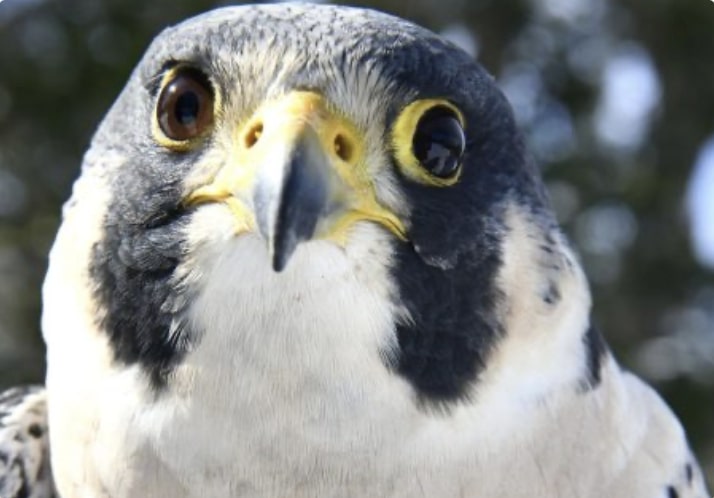
Nine years ago, a peregrine falcon arrived at the Evelyn Alexander Wildlife Rescue Center (EAWRC) with injuries too severe for release. Illegally shot, and maybe hunted, near Montauk, he was one of three falcons brought in around the same time, all victims of similar attacks. The other two recovered and were set free, but this one, now named Millennium, had suffered irreversible damage to his wing. Although this ended his life in the wild, Millennium began a new life as an EAWRC educational ambassador.
Tammy Flanell, Education Manager of the EAWRC, explains, “The circumstances surrounding the shootings were troubling. It’s hard to imagine that three falcons came in from the same area at the same time by coincidence.” She continues, “I’d like to believe maybe someone thought they were protecting their chickens, but it certainly seemed intentional.” The peregrine falcon is currently listed as an endangered species in New York State, and while it has recently recovered enough to be delisted federally, killing any raptor remains illegal.
When Millennium first arrived, his living space wasn’t the most ideal, but after joining the EAWRC staff team about 6 months after Millenium’s arrival, Flanell reached out to a raptor specialist at a rehabilitation center in Minnesota for advice. “She had me send pictures of all our enclosures,” Tammy explains, “She was kind about it and understood small places like ours don’t have big budgets, but she also explained that falcons don’t live in the woods and don’t perch on branches like other birds. They like flat surfaces, cliffs, and open views.”
Flanell completely redesigned Millennium’s space, replacing branch perches with rock-like platforms and flat resting areas to mimic a cliffside. “Now he’s always moving around and using all of his space. He’s so much more comfortable,” she furthers. That transformation also extended beyond his enclosure. Flanell became involved with the International Association for Avian Trainers and Educators, to further educate herself on raptor care. “In the past, our staff would just go in and grab the bird, but now we understand how stressful that can be,” she says, “Every time we go in should be like a mini training session, building trust.” Flanell even installed a camera in Millennium’s habitat to observe his behavior when no one is around. “He’s entertaining to watch,” she explains, “He hops around, bathes in his water dish, and uses every inch of his space. He’s just such a character.”
Despite his age, Millennium is still full of personality. “He’s probably around eleven or twelve now,” Flanell states, “He wasn’t a baby when he came in, and if he had been, he would’ve adapted faster, but he’s done so well despite that.” In the wild, peregrine falcons typically live around fifteen years, but in captivity, they can live much longer, “I’m hoping he’ll make it to twenty,” she adds.
Peregrine falcons are known as the fastest animals on Earth, capable of diving at over a whopping 200 miles per hour when hunting. “They mostly eat birds, and when they dive, they fold back their wings and strike midair, it’s amazing,” Flanell continues. In fact, “The B-2 bomber was modeled after the peregrine falcon,” she states, “If you look at pictures of both, they look exactly alike.” The government took full inspiration, and even the bombers’ engines have similar features to the little structures in the falcon’s nostrils that prevent their lungs from bursting during dives.
At the EAWRC, Millennium eats a diet of quail, chicks, mice, and an occasional rat. “He’s a bird hunter by nature,” Flanell explains, “He’s also my only bird that really bites. He has this little notch in his beak called a tomial tooth that helps him kill prey, but it makes him a bit of a handful during health checks.”
Millennium, during his time at the EAWRC, has become a favorite among staff and visitors, and “He has these bright yellow legs that look like little short pants, and he’s always strutting around. When we take him to programs, he’s so calm. He loves watching people talk and just being part of the conversation,” Flanell says. His favorite activity, however, is far from flying or hunting. “He loves baths,” Flanell continues, “That’s actually how we started bonding. He’d run through the sprinkler, fluff up his feathers, and play in the water. I have videos of him splashing around, it’s so sweet.”
As Millennium approaches his 10th year at the EAWRC, staff and wildlife rehabilitators remind hunters that shooting any raptor is illegal and immoral, and as much as Millennium is incredibly happy at the EAWRC, all animals will do better in the wild.
The Evelyn Alexander Wildlife Rescue Center is located at 228 West Montauk Highway, Hampton Bays. It can be reached at 631-728-4200, and animal emergencies can be reported at 631-728-WILD (9453). The center is open 9 a.m.–5 p.m. seven days a week. Visit wildliferescuecenter.org for more information.
Vetted Hamptons Resources