Activists & Artists in the Spotlight at 2025 Hamptons Doc Fest

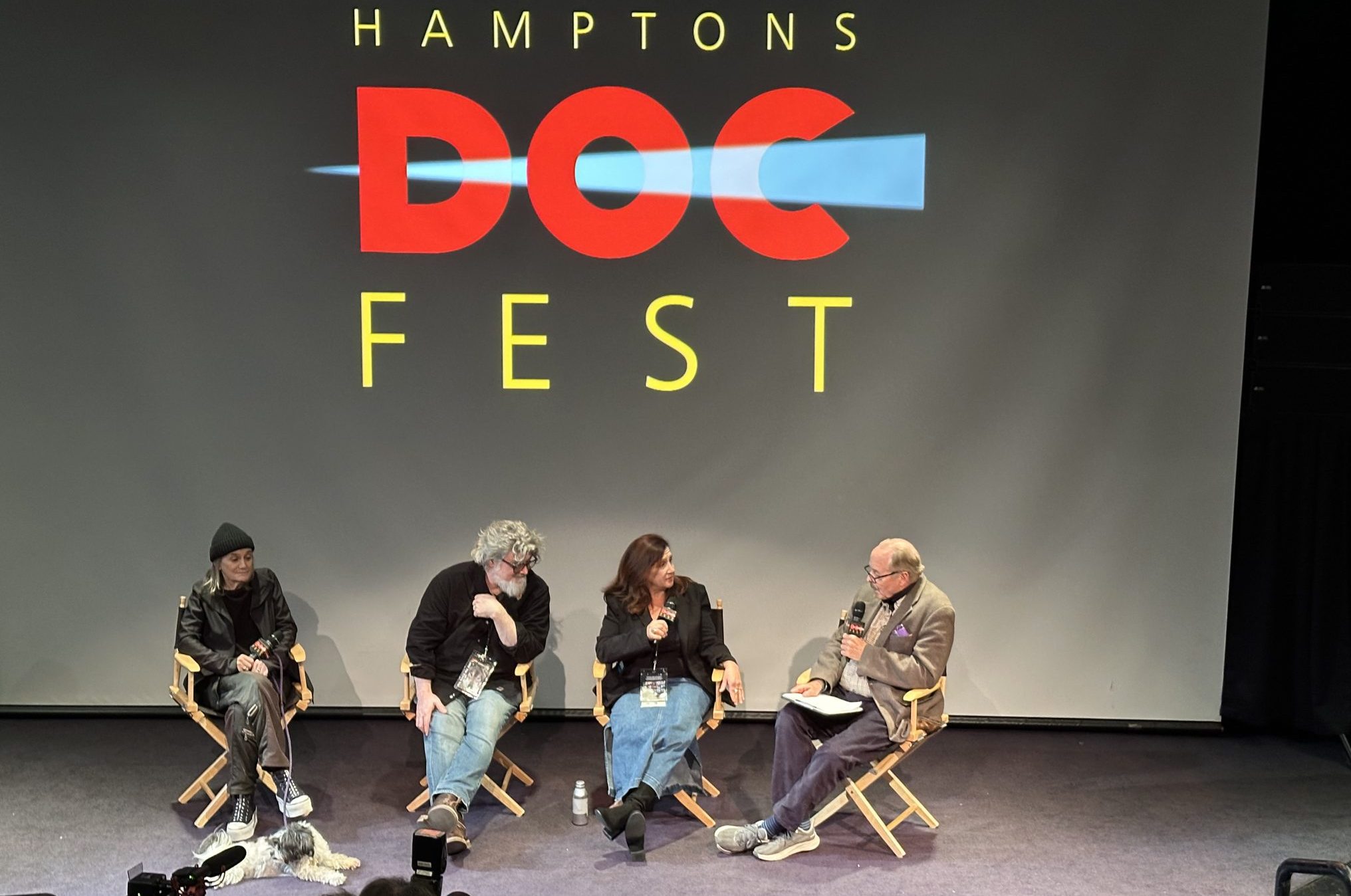
On a crisp week in early December, the 2025 Hamptons Doc Fest, now in its 18th year, presented a total of 33 films over eight days. Collectively, it was a dazzling display – a master class in storytelling.
Three of the most emotionally resonant films of the first half of the festival centered on three very different women and their fights against injustice and systemic abuse of various kinds.
This is a trio of films that many powerful entities would prefer you didn’t see. The filmmakers probably don’t have a lot of fans in the White House, for example; or the Vatican; or corporate America.
Steal This Story, Please!
A sold-out Bay Street Theater in Sag Harbor was home to the Fest’s Opening Night feature. Directed by Tia Lessin and Carl Deal, Steal This Story, Please! explores the remarkable life of independent journalist and activist Amy Goodman, who for three decades, has hosted Democracy Now!, a progressive daily news program which she co-founded, and which is now syndicated around the world.
As anyone who has followed her career will attest, Goodman is a badass. The film opens with her doggedly chasing an official in the first Trump administration up and down flights of stairs at a climate conference. At another point in the narrative, she asks George H.W. Bush how he would respond to those who call him a war criminal for bombing Iraq.
The documentary’ s prime directive is to highlight Goodman’s never-ending quest to cover stories that mainstream media outlets tend to overlook – sometimes for nefarious or nakedly political reasons. For example, the film points out that the East Timor genocide in Indonesia, which began in the mid-1970s and lasted for 25 years, was almost entriely unreported on by the media outlets from which the vast majority of Americans got their news.
“What happens to democracy?” the film’s production notes ask, “when the press surrenders to power?”
In addition to paying homage to Abby Hoffman, the film’s title is a plea to the mainstream media. Steal This Story, Please! refers to the idea that Goodman’s program isn’t interested in scoops or exclusives. Its mission is to get the stories it covers in front of as many people as humanly possible, regardless of how controversial or politically inconvenient those stories might be.
Nuns vs. the Vatican
A very different kind of hero fights a very different kind of institution in director Lorena Luciano’s Nuns vs. the Vatican, which won the festival’s Human Rights Award. The film introduces the world to Gloria Branciani, a former Italian nun who finds the courage to accuse a prominent Jesuit priest of rape and sexual abuse some 30 years after the incident occurred.
At this film’s core is the bravery of Branciani superimposed against the massive institutional failure of the Church. As Luciano explained at a Q&A after the screening, the Vatican views sexual abuse (whether it be against males or females of any age) as a sin rather than a crime. Without absolving it of its profound culpability, it’s instructive to view the Church’s actions – the denials, the cover-ups, the victim shaming – through that lens.
While reports of pedophilia in the Church were no longer uncommon when the film was made, public accusations of abuse of nuns by priests were all but nonexistent. The film notes that after Branciani made the decision to speak up, more than 30 survivors chose to come forward as well.
“[People] often ask us what kind of impact we envision with this film,” Luciano noted while accepting the Human Rights Award. “And I always say that we’re not politicians, we’re not lawmakers, we’re not activists. We’re storytellers. So our impact lasts for many years… Festivals like this and audiences like you are an important step because they bring the story to the world.”
Ask E.Jean
Jean Carroll, the pioneering female journalist, Hunter S. Thompson biographer, TV personality and former advice columnist for Elle magazine is about as far away from an Italian nun as you can get while still being a member of the same species.
But she shares one thing in common with Gloria Branciani, the principal subject of Nuns vs. the Vatican: Like Branciani, Carroll accused a powerful and institutionally protected man of rape many years after the fact – and people believed her. In Carroll’s case, two separate New York City juries believed her to the tune of a total cash award of $88 million.
The defendant was of course, Donald Trump, who was both a former and future President of the United States when the trials took place. As director Ivy Meeropol’s entertaining and extremely topical film also points out, Carroll still hasn’t received a penny of the settlement, which continues to be tied up in the appeals process.
In a fascinating segment, Carroll reports that she found the courage to speak out during the height of the Me Too era. She notes that she was particularly inspired by the women who helped bring notorious sexual predator Harvey Weinstein to justice.
Wary of reducing her subject to nothing more than “the accusation,” Meeropol’s film spends plenty of time on Carroll’s story as a journalist and pop culture personality. What emerges is a vividly realized portrait of a woman who refuses to be a victim – and who will not allow herself to be defined by the single worst event in her life.
The Fest’s first half also featured two films that shine a light on the lives and work of a pair of unique artists, both of whom, while revered in certain circles, have often flown just under the radar.
Jimmy & The Demons
A winner of the Art & Inspiration Award at this year’s festival, director Cindy Meehl’s portrait of the sculptor Jimmy Grashow is a monumental achievement. Meehl doesn’t shy away from the darkness and fear that informed much of Grashow’s work. We even learn that Grashow died not long after the film was completed. Still, this is an uplifting portrait of an artist in the twilight of his life and career.
Jimmy & The Demons refers to a commission Grashow accepted and worked on for the last few years of his life – a sculpture of Jesus Christ supporting a cathedral on his shoulders with demons encroaching from below and angels heralding a new order from above.
“I think this is a self portrait,” Grashow observes. “When I’m [making these] demons, I know that it’s a little boy playing and an old man being terribly afraid.”
The film is also a love story.
Grashow and his wife “Guzzy” – who is a powerful and charismatic presence in her own right – had a relationship for the ages. In these cynical times, the couple is inspirational. Their love is so genuine and so palpable on screen that it almost feels like a character unto itself.
Meehl’s film even manages to contemplate the idea of creativity as a form of redemption.
“I felt inadequate in every way,” Grashow says of his childhood. “I’m dyslexic, I can’t spell, I have no mathematical skills. Making art is the only thing I could ever do.”
Monk in Pieces
David Byrne and Philip Glass have been fans since the 1970s. Merce Cunningham was intrigued by her choreography. Bjork called her music “a gateway to the ancient” and even covered one of her vocal pieces. Yet Meredith Monk, the American composer, performance artist and filmmaker, is far from a household name.
As the film’s production notes point out, Monk is “one of the unique artistic pioneers of our time, but [her] cultural influence has largely gone unrecognized.”
Directed by Billy Shebar and David Roberts, Monk in Pieces is a stylistic tour de force – a mosaic that manages to open a door into Monk’s sometimes transcendently beautiful, sometimes maddeningly inscrutable body of work.
The film also spends a fairly significant amount of screen time deconstructing what is arguably Monk’s most popular piece – a non-traditional opera titled Atlas, which is loosely based on the life of the Buddhist writer and performer Alexandra David-Neel.
Like almost all of Monk’s vocal pieces, Atlas doesn’t use “words” as we understand the term. There are no lyrics in the traditional sense. In its review of a 2019 staging of the work, The New York Times described the vocals as “conveying meaning through tone, speed, rhythm, volume, texture, vowels, wild shrieks, low coos, flowing babble and rapid-fire stutter.”
While the filmmakers make liberal use of archival footage and audio recordings, a good portion of the present day material is shot in the downtown New York City loft/home studio where Monk has lived for over four decades. It’s in those scenes where the sometimes icy veneer of the performance artist drops away and the human being behind the work emerges.
Vetted Hamptons Resources