FRINGE: The Interior Wilderness
 By Avalon Ashley Bellos
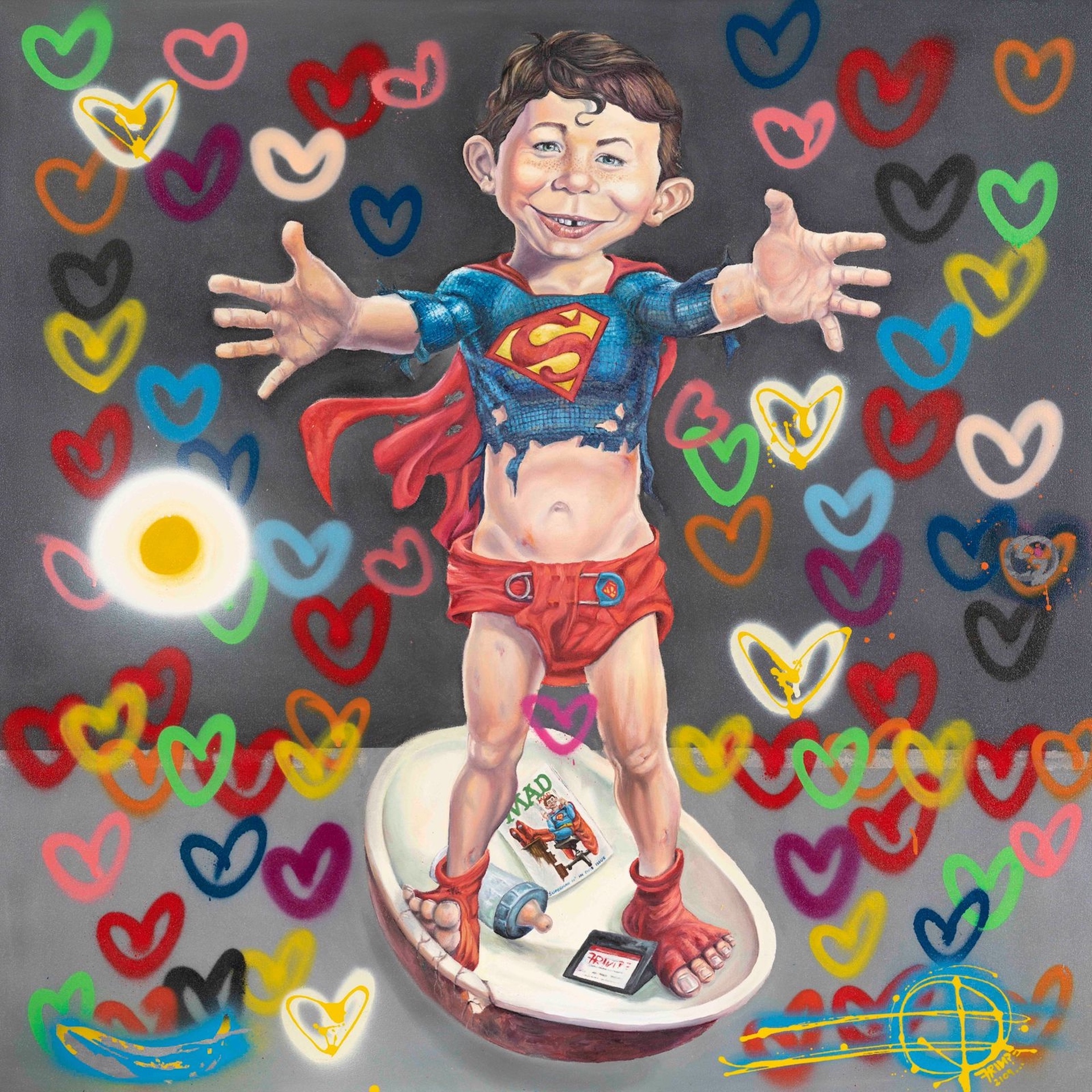
FRINGE does not enter the frame quietly; he arrives like a beautifully controlled disturbance. There is something seductive in the immediacy of the work, yet something far more destabilizing beneath it—a polished visual language carrying the residue of memory, pressure, ghosts, and private unrest. Born in South Africa in the late 1970s and shaped first by the architecture of the corporate world before fully turning toward fine art, he makes work that understands systems intimately enough to bend them. Pop iconography, brand fluency, psychological tension, and emotional aftershock all collide in a practice that feels at once culturally legible and deeply internal. The White Room Gallery, the first gallery to represent FRINGE in the US, places this psychological terrain within a broader contemporary dialogue through Wild Things, though the true subject remains the interior wilderness he continues to map in real time.
- You began in the corporate world before turning fully to fine art. What made that shift inevitable?
I did not leave the corporate world so much as realize it was politely suffocating me in a well-tailored suit. Every strategy deck felt like performance without honesty. Art offered something corporate life never could: the freedom to answer to instinct instead of governance. The irony is that corporate life trained me well in discipline, structure, and endurance, but art finally gave me permission to breathe.
- How did branding and visual messaging shape the symbolic language of your work?
Working in branding taught me how easily meaning can be manufactured, polished, and sold. That made me less interested in controlling interpretation and more interested in letting meaning slip. Branding wants clarity and command; art survives through ambiguity, contradiction, and misreading. That tension remains central to how I work. - Was there a moment when you realized you were not abandoning one system, but absorbing it into your artistic vocabulary?
Absolutely. There was never a clean break. Everything feeds everything else—corporate structure, branding, human behavior. I did not leave one system behind; I absorbed it and let it evolve into something more honest. Art is not an escape. It is an accumulation. - Your work merges pop iconography with emotionally charged imagery. What draws you to symbols that live in both commerce and collective memory?
I am drawn to symbols because they already carry weight. Some are loud and instantly recognized; others are quiet and half-buried. The compelling space is where those two worlds meet. Pop imagery gives you the surface recognition, but emotion changes the charge. That is how life works, too: loud on the surface, quieter and far more complex underneath.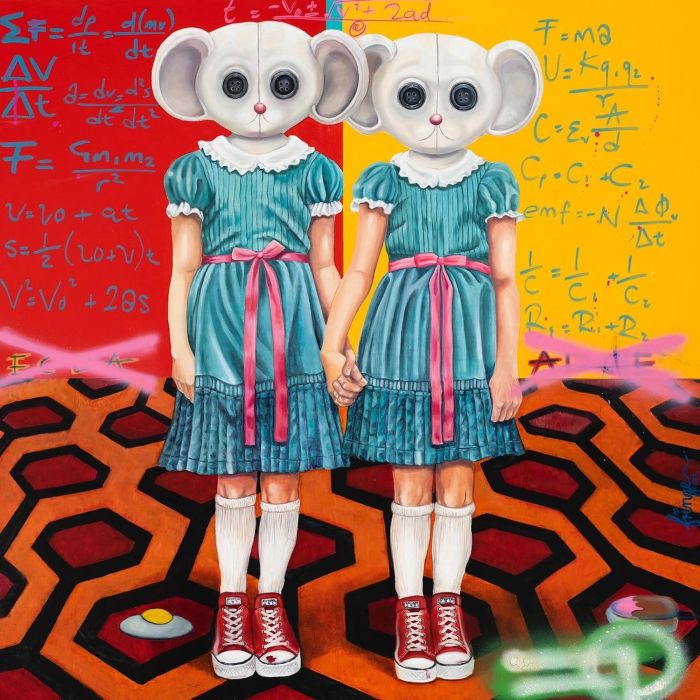
“ECDA-ADCE” by FRINGE, also on display at The White Room Gallery. - Your images are instantly legible yet psychologically unsettling. How do you hold visual accessibility and emotional depth in the same frame?
I do not try to resolve that tension. Accessibility simply gives the viewer a way in. What happens after that is where the discomfort begins. A work can be visually immediate and still remain emotionally unresolved. In fact, that contradiction is often the point. - You move between painting and sculpture. What does material resistance open up for you?
I actually prefer flat surfaces. I love pushing a painting until it begins to feel almost sculptural without leaving the wall. Sculpture, though, introduces weight, gravity, texture, and a real physical negotiation. What surprised me most is how much I enjoy the collaborative rhythm around it—problem-solving, momentum, shared focus. It echoes the structure of corporate life, but this time on my own terms. - When a new work begins, what comes first: image, emotion, or tension?
Usually fun. There has to be play, curiosity, and a sense of energy at the beginning, or the work feels forced. Deadlines complicate that, of course. Then the process becomes a negotiation between freedom and delivery, which is often where the work finds its pulse. - Your exhibitions sell out consistently, yet your answers suggest a healthy distrust of applause. How do you reconcile success with authenticity?
I do not distrust applause so much as refuse to fully relax into it. Success is something I am grateful for, though I think most artists quietly expect the crash at some point. That awareness keeps me grounded. Commercial success and emotional authenticity are not opposites for me; they simply exist beside gratitude, insecurity, and the need to keep working. - Beneath the surface of the work are memory, ghosts, and unfinished emotional business. How does personal history enter the studio without becoming an autobiography?
Personal history enters indirectly. I am not interested in retelling my own story. Memory, ghosts, unfinished emotional business—those are universal states, not private confessions. They come through instinct, gesture, and decisions made in the moment. It is less about explanation and more about letting fragments leak into the work without forcing them to identify themselves. - Your work appears in Wild Things at The White Room Gallery. How does the idea of wildness intersect with your current visual and psychological concerns?
I am South African, so wildness has never felt theoretical. For me, it is psychological as much as physical. It is the part of the mind that resists order, the idea that refuses to behave, the undercurrent beneath what appears controlled. I do not think wildness is something to tame. I think it is something to understand—and to decide how much of it you are willing to let show.
Vetted Hamptons Resources