Language Awakening: Erasure & Resurgence of Long Island Algonquian
 By Omar Drissi
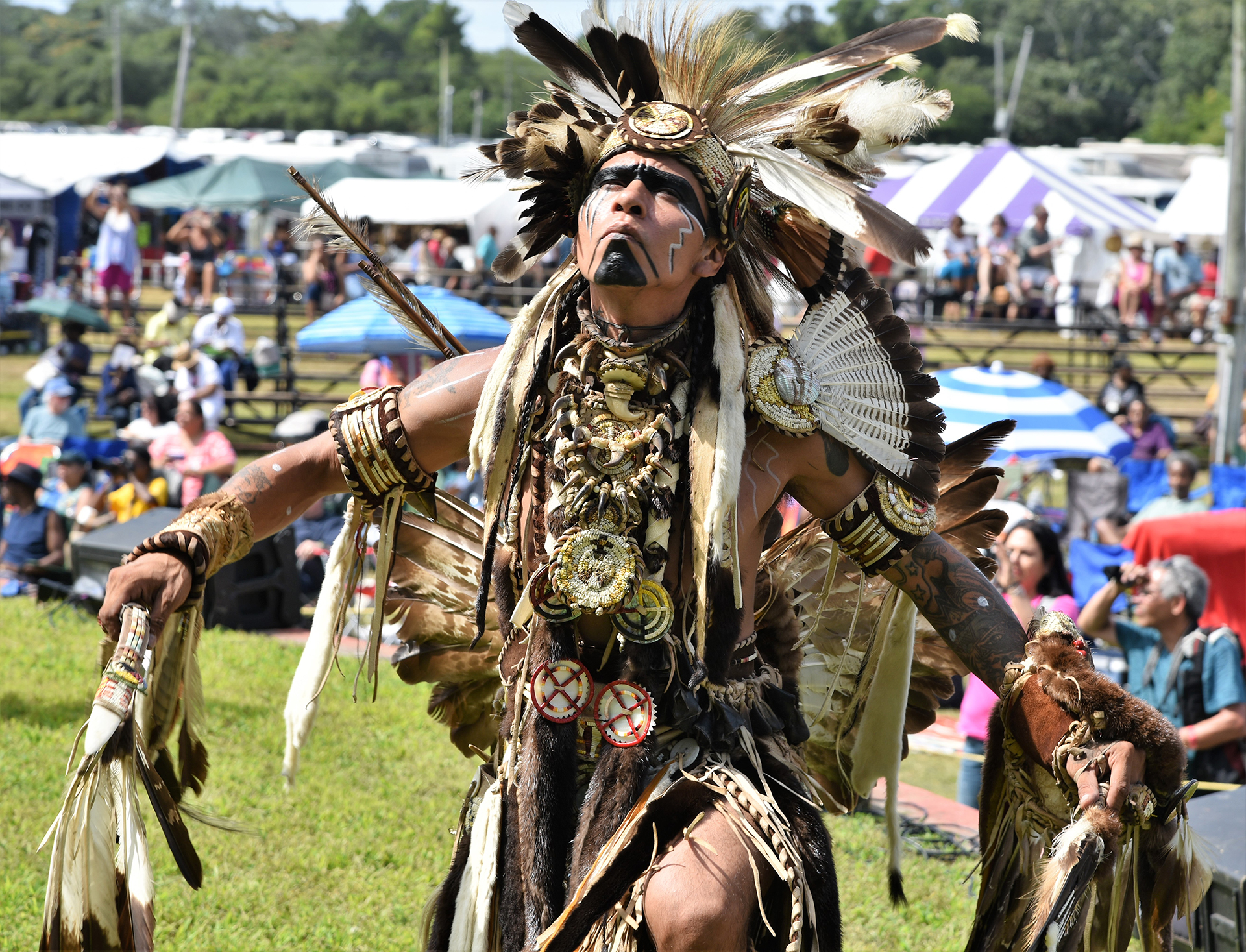
For decades, the Indigenous people of Long Island have worked hard at revitalizing Long Island Algonquian, their mother tongue which has no living fluent speakers. In 2017, Stony Brook University committed its resources to helping the effort by establishing the Algonquian Language Revitalization Project.
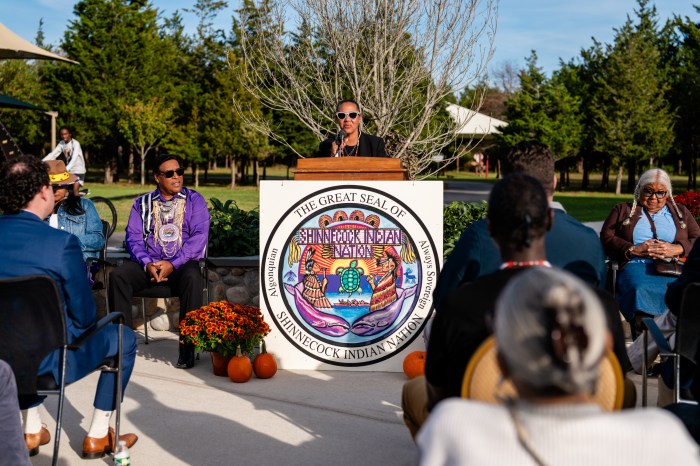
Members of the Algonquian Revitalization Project shared the latest on their efforts during a recent Indigenous art exhibit, Weaving Words, Weaving Worlds, at the Zuccaire Art Gallery.
“A lot has been written about revitalization,” said New York State Justice Lizbeth Gonzalez, who serves on the Appellate Division, First Department, leads the Algonquian Language Revitalization Program and helped organize the exhibit. “What it really means has everything to do with standing up for your people, and fighting back against assimilation.”
Assimilation — for the better part of American history, Indigenous children were yanked from their homes and plopped into Indian boarding schools, where students were beaten when caught speaking their mother tongue, denied food, placed in solitary confinement and accused of Satanism. Lye soap was thrust into their mouths to cleanse them of the devil. The kids would come home, once or twice a year, to the reservations. They were quieter, almost strangers, and that’s how Long Island Algonquian faded away, experts say.
“What we’re doing,” Lizbeth continued, “is challenging as there are no fluent speakers. There’s a race to record the wisdom of elders before they pass away so that the language’s wonderful words and sayings and funny stories don’t get lost.”
Lizbeth takes issue with Algonquian being described as a dead language family. It’s dormant, she insisted — asleep, not dead.
Long Island is home to two indigenous tribes that have state recognition: The Shinnecock, who are also federally recognized and whose territory is in Southampton, and the Unkechaug, who reside on the Poospatuck reservation in Mastic. A third, the Montaukett were denied it. Montaukett recognition legislation has been vetoed six times in the past decade, most recently in December, by Gov. Kathy Hochul. All three speak an Algonquian dialect
Back at the art gallery, four Native Americans came to discuss their work on display at the gallery.
“I want to start,” said the discussion leader, a member of the Shinnecock Nation and a Stony Brook alum, “by acknowledging that we’re on the traditional lands of the Setalcott People, who still maintain a descendant community just a five minute drive from Stony Brook University.”
The man to his right wore a felt ranger hat from which two jet black braids hung. His skin was caramel and a seashell necklace, handmade, dangled on his chest.
“Hello everyone, my name is Tecumseh,” he said. “I’m Unkechaug, I’m Turkey Clan and I’m a wampum carver and cultural consultant.”
He’s also Matinecock, Montaukett, and a former student of the Revitalization Program.
“There’s this intentional disconnect,” he said, “that colonialism pushes with our connection to our land, our connection to our food, our connection to our animal relatives…”
Tecumseh paused, pondered for a moment. His contribution to the gallery hung beside him. Titled Water Connects Us All, a water droplet’s silhouette was filled with dozens of indigenous words for water: Nebi, Nupi, Nipi…
“We use the word ku-nahakahki — everyone’s — to understand our relationship to Mother Earth,” he continued. “We never use the word nu-nahakahki, which means mine and not yours. That’s not how we think of it.”
He explained that attitudes exist in language systems, and that to quell a language is to suffocate a worldview. He gave an example:
“The word we use often to greet is aquy (uh-kway). It’s often thought of as hello, but what it really means is I see the light in you. We don’t just say aquy to humans. We say aquy to the animals, to the trees, because all of those are living beings, and that speaks to how we view all of creation as our relatives.”
Revitalization, he believes, can succeed only if the many Algonquian dialect speakers — across Long Island, across America — come together. Their words denoting water, after all, are strikingly similar.
Leighton Delgado is one of the founders of the Algonquian Revitalization project at Stony Brook. He’s also the linguist tasked with assembling the latest Long Island Algonquian dictionary, his project of several years.
“I call it language reclamation,” he said in an interview, “because a lot of these Algonquian words translated by English people are completely wrong.”
As Leighton and company have begun to reclaim the language, they’ve repurposed the very thing that first took Algonquian from the Americas centuries ago: John Eliot’s Indian Bible, which was the first published in Algonquian when it was printed in 1663.
Eliot’s Bible provides a blueprint — hazy but essential — for what the dormant language once had been. A translation of the King James Bible, it contains more than 10,000 unique words in Algonquian. By placing the Indian Bible beside its source material and comparing each word, linguists have rediscovered the language’s bones.
Of course, the text’s syntax, being a word-for-word translation of old English scripture, lacks the rhythms and construction of spoken Algonquian. To learn the proper speech patterns, Leighton and company had to consult other sources.
“The most important source we used,” said Leighton, “was the diary of a Mohegan named Fidelia Fielding.”
Fidelia Fielding, for much of her life in the late 19th and early 20th centuries, was the only living speaker of Algonquian’s Mohegan dialect.
“She didn’t have anybody to speak to, but she didn’t want to lose her language. So she created a diary, and every single day she would write what she did. What that gave us was ‘Oh, so that’s how you speak Algonquian’, not ‘Moses said to this disciple blah-blah-blah-blah-blah.’”
In 2006, Stephanie Fielding, a linguist and descendent of Fidelia’s, published A Modern Mohegan Dictionary, a book that standardized an Algonquian alphabet composed of 18 Latin letters. She consulted her ancestor’s diaries for reference, and dedicated the dictionary to her memory.
Leighton uses the text to teach his students in Stony Brook’s Revitalization program. The classes have been held on Zoom since the pandemic, and the students are a mix of Indigenous folk — young and old — and Stony Brookers. Each session begins with reciting a Four Directions prayer in Long Island Algonquian. Then, together, they tell stories in the language. Every student contributes a sentence.
At times they get stuck. The Eliot Bible and other reference texts don’t always contain the words they need. Together, the students and Leighton create words. A ‘supermarket’ is a big food place; ‘car’, mysterious wagon. And waterfall: Nupipánshák — water that it falls.
The project is done a few dozen miles north of The Shinnecock Indian Nation territory, which sits on a 1.3-square-mile plot in Southampton. More than half its inhabitants live below the poverty line.
“I always tell people you’re not going to undo four or 500 years of colonialism in the next year,” Tecumseh had told me once, “or in 10 years or even in 20.”
The arc of progress is long; the work, ongoing.
At the Shinnecock Nation’s Wuneechanuk Shinnecock Pre-school, teachers have begun to speak bits of Long Island Algonquian to the children, who range from six weeks old to the age of four. Paulette Brown, the school’s assistant director, is in one of the advanced classes that Leighton teaches. She’s learned the language since 2018 and brings her knowledge into the Pre-K. She teaches her students to count. She teaches them color.
“We have some toddlers here who I’ve had the pleasure of teaching since they were very young,” Paulette told me once. “I can speak to them in simple Algonquian sentences and they’ll understand it well because for them, it’s just like speaking English.”
The kids bring packets home. On them, Paulette and her colleagues have printed several phrases in Algonquian, along with their English translations. They come home, the children, and teach Algonquian to their parents.
In The Beginning
“Indios,” Christopher Columbus declared at the sight of the Arawak, “Indios.”
When his longboat collided with the Caribbean shore, he thought, famously, that he’d landed in the Indies. Unbeknownst to him, a continent twice the size of Europe stood between his crew and the Spice Islands; on it stood five to ten million people spread across thousands of miles. But in 1492 they were called Indians — all of them — and the word stuck. Over the following centuries, missionaries traced Columbus’ slipstream to the continent. They ventured ever deeper into The New World.
It’s hard to determine precisely where the missionaries’ religious conviction stopped and economic interest began, but it’s worth considering both when analyzing An Act for the Promoting and Propagating the Gospel of Jesus Christ in New England, legislated in 1649:
The Heathen Natives of [the Americas], through the blessing of God upon the pious care…of some godly English of this Nation who preach the Gospel to them in their own Indian Language, who not only of Barbarous are become Civil, but many of them forsaking their accustomed Charms and Sorceries, and other Satanical Delusions, do now call upon the Name of the Lord, and give great testimony of the power of God drawing them from death and darkness, into the life and light of the glorious Gospel of Jesus Christ, which appeareth by their diligent attending on the Word so preached unto them, with tears lamenting their mispent lives.
The act codified a litany of descriptives for native peoples — see ‘Barbarous’, ‘satanical’, etc. — and exaggerates, surely, their desire for Christian deliverance. Nor does the act shy from linking the success of prior missions to language: The Gospel, to hold sway, had to be preached to natives in their own tongues.
Crucially, the legislation made mission work a concern of the crown. The first British missions to the Americas were for the most part funded privately. But once the crown sniffed soft power, it established The New England Company, a state-run funding apparatus. Most significantly, The New England Company bankrolled the colonial efforts of Reverend John Eliot, which were rooted in linguistics.
In 1631, John Eliot, a British puritan missionary settled in present day Massachusetts. Over the following decades, he evangelized about 4,000 indigenous people. He called them Praying Indians in his letters back to Britain, and he cordoned them off into fourteen villages, each governed by anglo jurisprudence and custom.
Despite being accustomed to a notably fluid division of labor, the indigenous men worked the fields in Eliot’s praying towns while the women, who traditionally farmed too, stayed at home. Their children were dressed in petticoats, trousers and shirts made of linen. To accelerate assimilation, polygamy, traditional ceremonies, and work on the Sabbath were outlawed in praying towns. By most accounts east of Boston, Eliot’s evangelization efforts were a great success.
He owed that to his Indian Bible.
“What an honour it will be to this whole Nation, that the Holy Bible should be printed in our days and at our cost in a Language and for a Nation which never had it to this day,” he wrote in 1660. In keeping with 1649’s Gospel Act, he endeavored to translate the Bible into an Algonquian dialect spoken by the Massechusett people. He recruited at least three Praying Indians as interpreters and set to work documenting the language.
But the Algonquian family’s status as primarily oral made written translation difficult. So, to assemble the text, Eliot sounded the language out and forced each noise into latin letters as best he could.
His transliterations were similarly clunky. Many Biblical concepts had no equivalent in the Algonquian language family. They simply didn’t exist. While the natives had terms denoting good and evil, the idea of sin was foreign; the concept of an angel was also unfamiliar. And God: in many indigenous traditions, divinity doesn’t exist in the heavens, removed from the world below. Divine spirit courses through everything. Is everything.
Sin became Matcheseonk.
Angel became Angelsumoh.
God was retained.
In 1663, John Eliot completed and distributed Mamusse Wunneetupanatamwe Up-Biblum God, The Holy Bible, which some scholars cite as the first book published in North America.
Over the centuries, the Algonquian languages faded. It was the Praying Towns, it was the boarding schools, the land theft, the wars and the displacement. In 1887, turning the blade, the United States government outright banned native tongues in schools. It took until 1990 for an explicit legal reversal.
Accounts vary, but sometime between the late 19th century and the early 20th the last fluent speaker of Long Island Algonquian was dead.
Vetted Hamptons Resources