The Great Eastern Legend: A Historic Crash Off Montauk
 By Dan Rattiner
The news last week was all about the rocket Artemis II taking American astronauts back to the Moon. Also supertankers in the Strait of Hormuz trying to bring barrels of oil to customers around the world.
It’s got me thinking about the story of the HMS Great Eastern, the largest ship in the world during its time, and its wild encounter just off the Montauk Point Lighthouse. What happened might have changed the course of local history and made this ship a legend. But it never did.
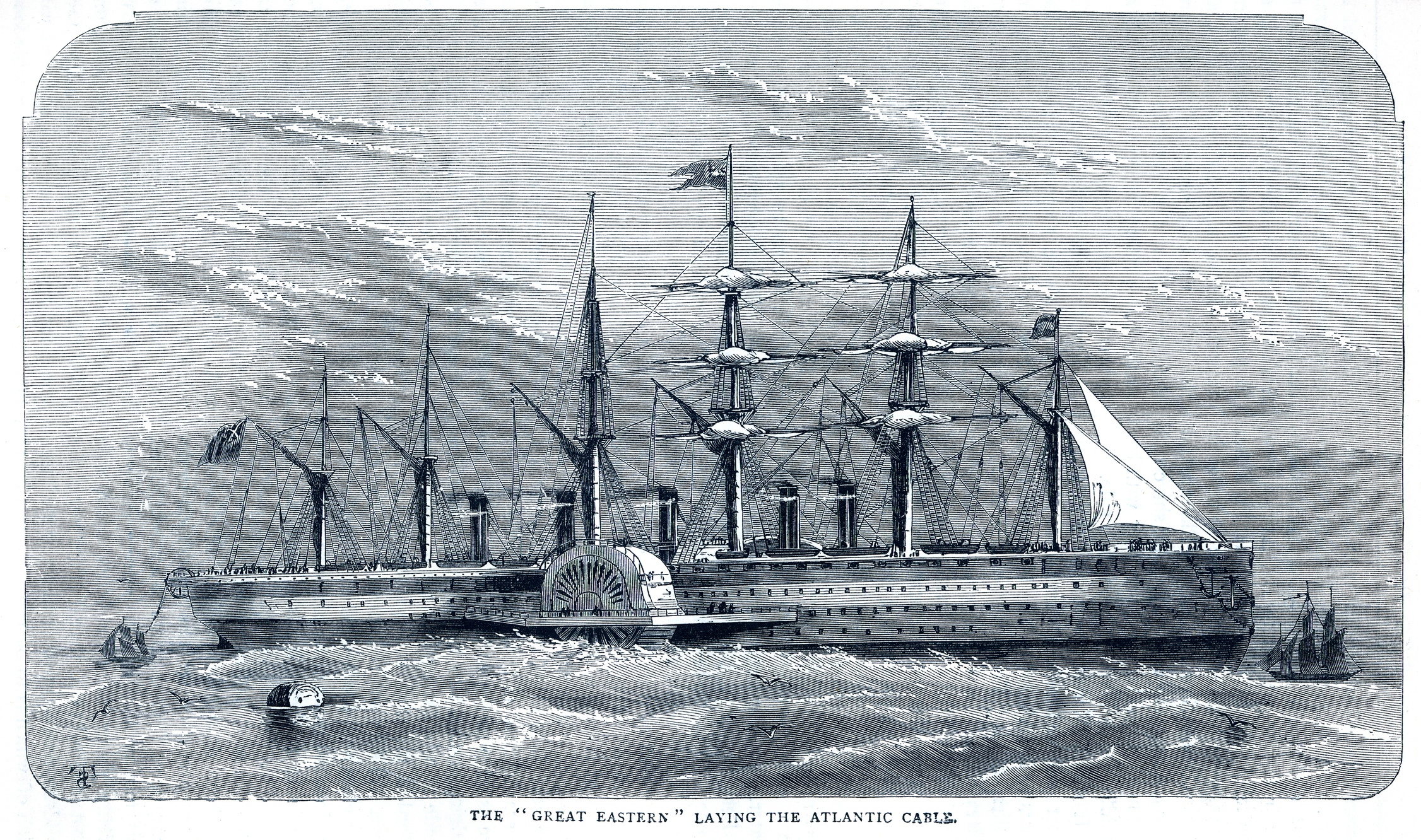
On the morning of Aug. 27, 1862, the keeper of the Montauk Point Lighthouse, William Gardiner, walked onto the front lawn to greet the day. There he saw the largest ship in the world, by volume six times the size of any other, standing broadside a short distance off the cliff upon which he was standing. It was a stunning sight.
He’d read about it in newspapers when it was launched in England in 1858, but he never imagined he would see this monster. The Great Eastern was a passenger ship that could carry up to 4,000 wealthy guests. It was nearly 700 feet long, and was powered by masts and sails, paddle wheels, a propeller, and steam engines. One paddle wheel was on the port side, one on the starboard. Above deck, six masts with sails alternated with five smokestacks belching coal smoke. Any two of the three power sources could inch this giant monstrosity forward at 14 1/2 knots. It was certainly like no other ship in the world.
A few passengers were seen on deck, along with some of the 418 crew members running this way and that in panic. The ship was not moving.
Gardiner ran back inside the lighthouse living quarters and woke his wife and teenage son, urging them outside. They quickly dressed and ran out. They all gaped at this wonder of the age.
And then, out of breath and standing there with his family, Gardiner saw there was something wrong. The Great Eastern was listing 10 degrees to starboard.
My God, he thought. It’s struck something.
* * *
This ship had been built by British shipping magnate Isambard Kingdom Brunel between 1852 and 1858. At the time, there was a growing demand for passenger steamships to ply the Atlantic between England and America. Many small packet ships, each carrying several hundred people, had been built. Drawing in a sketchbook, Brunel wondered if one gigantic steamship could do the job more efficiently if, for example, it were the size of six smaller ones. It could carry more coal. It could even, if his calculations were correct, go all the way from England to Australia without refueling. It would be a sensation. But could it be done?
He consulted the famous naval architect and shipbuilder John Scott Russell, who told him yes, it could, but it would have to have an enormous amount of power to survive the high seas in a storm. Russell said that four 2,000 horsepower engines, the strongest engines known at the time, could move it forward at 14 knots easily in calm seas but with more difficultly in heavy seas. It might be rough to control. In any case, having the three forms of propulsion would reassure everybody, especially skeptical passengers who had never seen the likes of this before.
Brunel went ahead. It would be more than 50 years before a larger ship was built. That’s how long it took the shipbuilding industry to get over the Great Eastern.
What happened to it has never risen in the mind of the public to any legendary status. The stories of RMS Titanic, the USS Arizona, the ironclads, and the Mayflower take up most if not all of that oxygen.
Perhaps the reason for this is that the Great Eastern did not sink after hitting the underwater rock. It limped into New York City still listing. A great 83-foot-long gash was found in its outer hull. But its inner hull held. It was repaired.
In the years that followed, the Great Eastern endured an incredible number of further catastrophes. And in the end, when it was being torn apart for scrap in 1885, legend has it that the skeletons of two workmen were found between the outer and inner hull. They had died when trapped there at the end of a workday when this monster was built 30 years earlier.
The singer Sting, who lives in Montauk, co-wrote “Ballad of the Great Eastern,” a sea chanty that he thought might bring the legend of the Great Eastern to life. Excerpts below:
A riveter was on the hull with his apprentice lad,
He’d served his time with the older man, some say it was his dad.
200 men upon the shift but when the day is done,
The count is hundred 98 before the setting sun,
They searched the yard all through the night until the morning bell,
No more delays are countenanced by Isambard Brunel.
During the ship’s launch, a worker was killed by the whiplash of a rope. Another died fleeing snapped chains. Soon thereafter, while the ship was still being fitted with stained glass, chandeliers, gaslights and furniture, Brunel died of a heart attack.
During her sea trials, one of the engines exploded, sending a smokestack crashing down to kill two crewmen and set the sails on fire. Six boilermen died.
When a squall came up, the captain, his son, and the coxswain fell overboard to their deaths.
On a later crossing, two paddlewheels collapsed in another storm. The sails caught fire again, then flew off. After that, a giant block and tackle struck and killed the quarter-master.
Twice the ship’s crew mutinied at sea, once for higher pay, the second time for not being paid. Eventually, stripped of its luxury fittings, it became just a cargo ship and, for awhile, a floating advertisement. With enormous billboards on its sides, it promoted a circus, a restaurant, a theatre production, and food products as it plied up and down the Thames visible to potential customers on shore.
Only if it had sunk at Montauk would its fame have altered the course of the history of eastern Long Island. But it didn’t.
Vetted Hamptons Resources