Padina Bondar Brings Medieval Bunnies to the Brilliant Now
 By Avalon Ashley Bellos
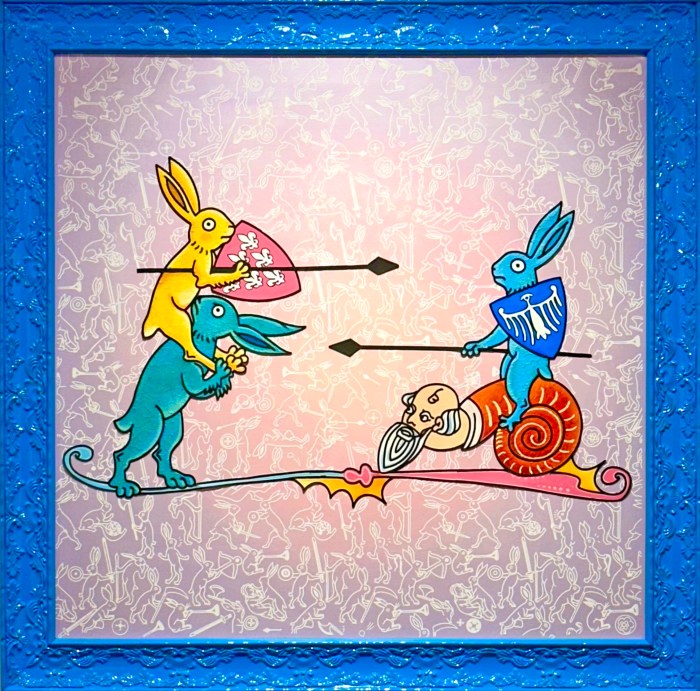
In the dim, gold-leafed hush of a 13th- and 14th-century scriptorium, where monks bent over vellum with a discipline that bordered on the devotional, the official narrative of the page was never the only one being told. Beyond the sanctified center — beyond the saints, the scripture, the rigid hierarchies of belief — there thrived another language altogether. Along the margins, where the eye might wander and authority softened its grip, rabbits rose up on hind legs, armed themselves with spears, and pursued knights with unnerving confidence. Snails confronted soldiers. Monkeys mimicked clergy. It was absurd, certainly, yet also deliberate. These images — now understood as marginalia — were not careless embellishments. They were acts of coded resistance, early visual arguments that power could be inverted, that order was not as fixed as it claimed to be.
Art history, when read closely, reveals that artists have always found ways to speak where speech was constrained. The Gothic manuscript gave way to the intellectual ferment of the Renaissance workshop, where disciplines were fluid and the hierarchy between art and object had yet to calcify. Centuries later, the provocations of Dada would dismantle reason in the aftermath of war, while Pop would mirror the excesses of consumer culture back onto itself with a smile that was never entirely sincere. Each movement, in its own way, has negotiated the tension between beauty and critique, ornament and opposition. Each has asked, in different terms, how an image might hold both pleasure and unease simultaneously.

It is within this lineage — this long, unruly history of subversion disguised as delight — that Padina Bondar emerges, not tentatively, but with a clarity that feels both inevitable and urgently of the moment. She does not simply reference history; she activates it. Her work carries forward the logic of those medieval margins and repositions it within a contemporary landscape defined by environmental fragility, political spectacle, and a culture saturated with its own excess.
To encounter Bondar’s practice is to recognize, almost immediately, that she is not operating within the confines of a single discipline. She moves between visual art and fashion with a fluency that resists categorization, and crucially, without the strain that often accompanies such hybridity. This is not a performance of versatility. It is an integrated language. Her garments think like sculptures. Her paintings carry the sensibility of textile. Material, in her hands, is never passive. It is narrative, evidence, and argument all at once.
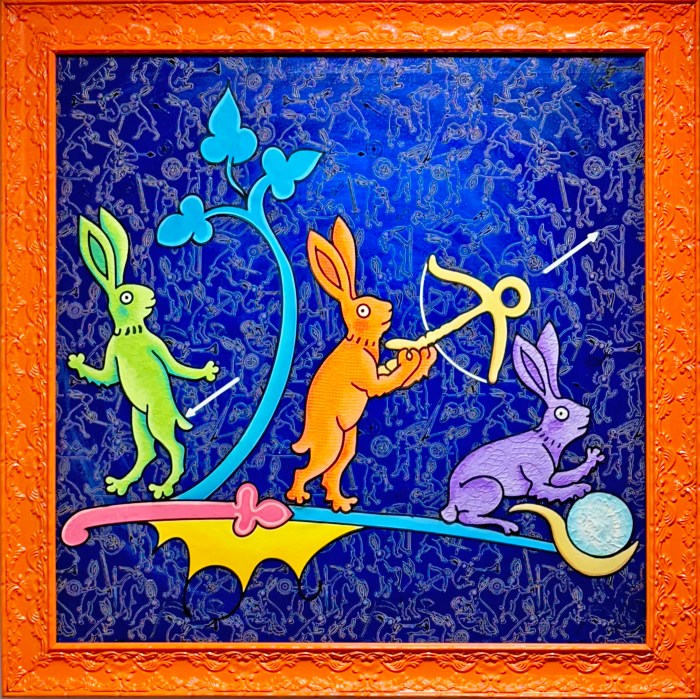
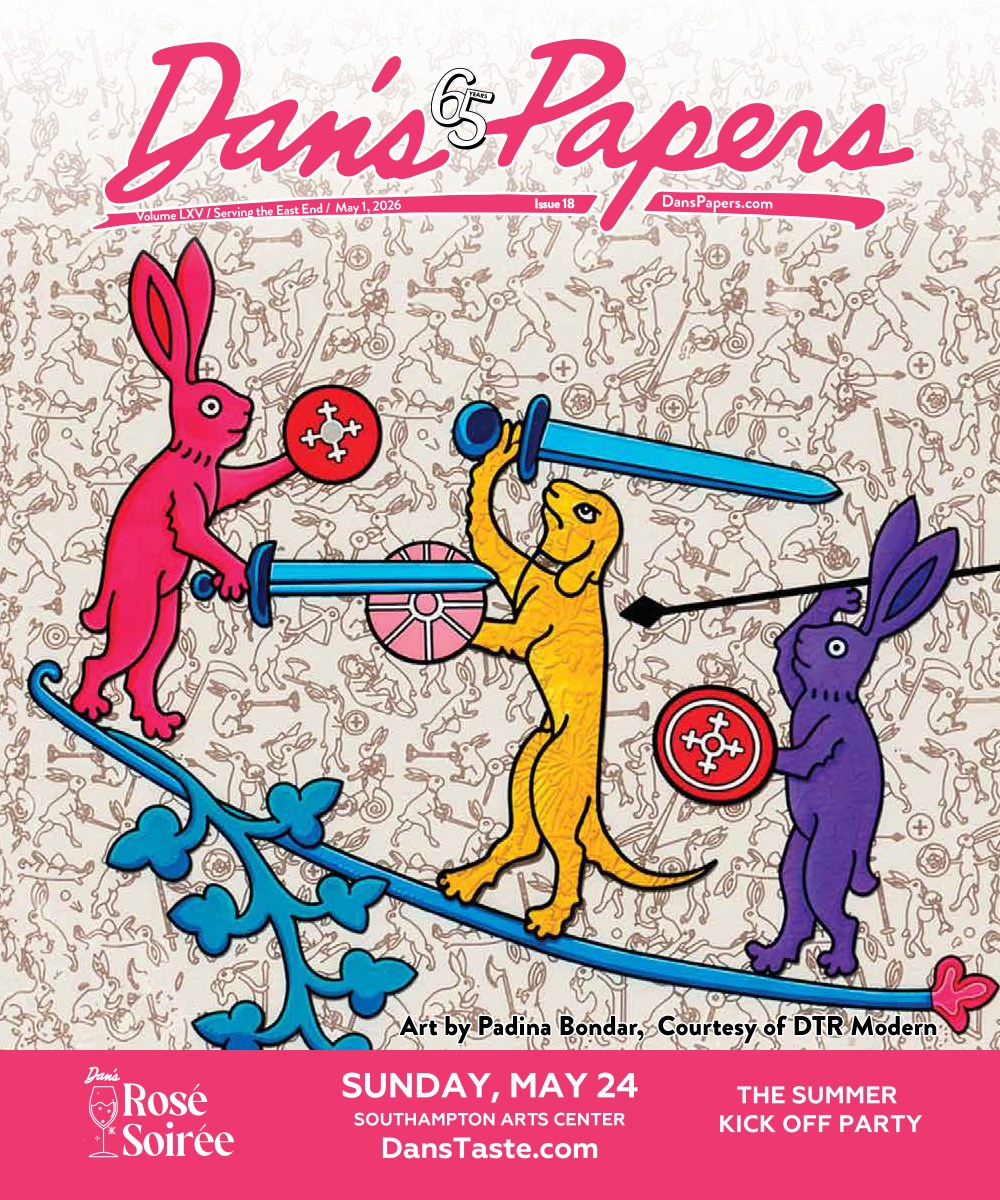
Her Killer POP Bunnies – Series I resurrects the medieval “killer rabbits” with striking conviction, drawing them out of obscurity and into a contemporary visual field charged with color, texture, and conceptual density. Saturated hues collide across layered surfaces of fabric, paper, and acrylic, building compositions that feel as though they have been excavated rather than composed. The figures — once small, almost conspiratorial presences at the edge of sacred texts — now command the viewer’s attention. They no longer whisper. They confront.
There is, notably, an emotional elasticity to these works. They oscillate between humor and discomfort, seduction and critique. One is drawn in by their visual immediacy, their almost playful intensity, only to realize that the laughter they provoke is edged with something sharper. The medieval appetite for absurdity — its willingness to destabilize logic and mock authority — reappears here not as nostalgia, but as a living strategy. Bondar recognizes, perhaps more clearly than most, that absurdity remains one of the most potent tools for revealing truth.
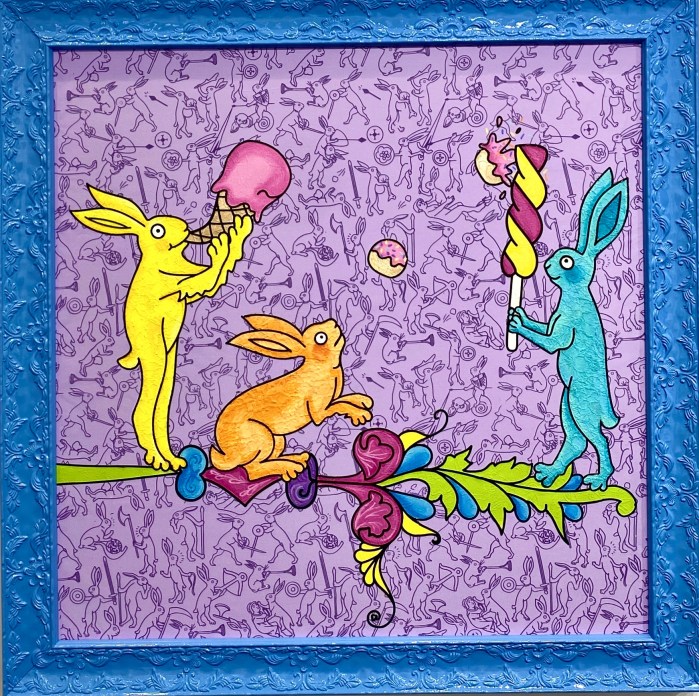
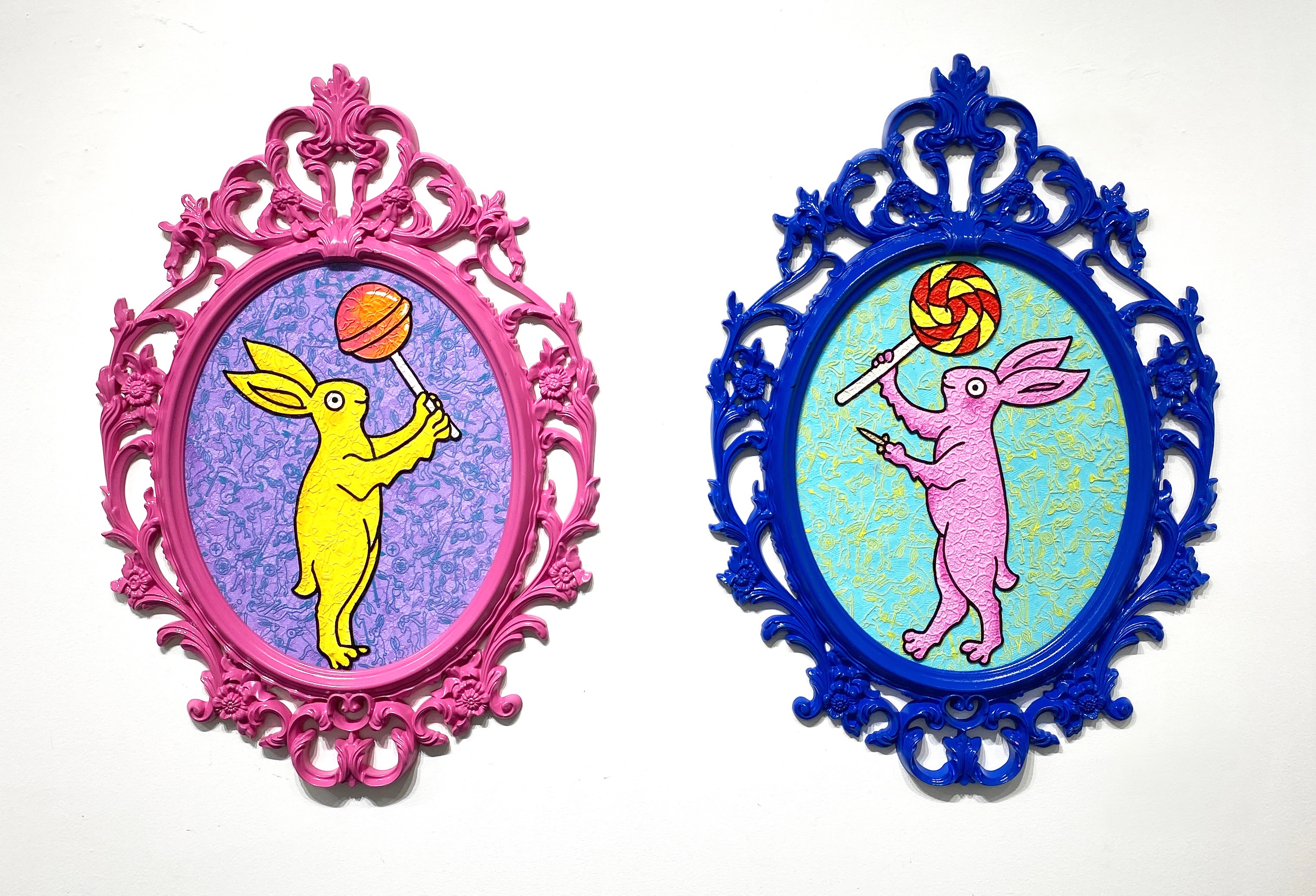
In the second series, the transformation of the rabbits becomes even more pointed. Weapons are set aside, replaced by lollipops, ice cream cones, and oversized confections. The gesture is disarming, even charming at first glance, yet it carries a deeper, more unsettling resonance. In a global climate marked by persistent conflict and spectacle, the substitution of violence with sugar does not neutralize the image. It reframes it. The candy becomes a symbol of distraction, of indulgence, of the veneer that often masks systemic instability. These figures — armored, composed, yet clutching symbols of excess — pose a question that lingers: Are those who wield power any less performative than the images that critique them?
Material remains, without question, central to Bondar’s thesis. Her continued use of repurposed refuse — plastics salvaged, transformed, and elevated into textiles and surfaces of remarkable refinement — grounds the work in a reality that cannot be abstracted away. This is not sustainability as aesthetic gesture. It is sustainability as insistence. The materials carry their histories with them, their prior lives embedded within the final form. In reworking them, Bondar collapses the distance between critique and creation, offering a model that is at once practical, poetic, and quietly radical.
As she prepares for New York Fashion Week this fall, Bondar extends this inquiry into the realm of the body. The garments, constructed through the same processes of transformation, move beyond static display into lived experience. They ask what it means to wear history, to carry the weight of material awareness into motion, to inhabit a form of luxury that does not deny its origins but instead reveals them. Within an industry historically defined by cycles of consumption and obsolescence, her presence introduces a necessary recalibration.
Artists, historically, have been the early interpreters of rupture. They have translated the unease of their time into forms that can be seen, felt, and, perhaps, understood. Bondar stands within this continuum, though her voice is distinctly her own — one that balances rigor with wit, critique with elegance, and urgency with a kind of measured, enduring grace.
To engage with her work now is to encounter not only a compelling aesthetic, but a reconfiguration of value itself. Collectors attuned to the shifting terrain of contemporary art will recognize that what is at stake here extends beyond form. There is a worldview embedded within these works — one that insists beauty and responsibility are not opposing forces, that humor can carry the weight of critique, and that materials, no matter how discarded, remain capable of transformation.
Her rabbits, poised somewhere between satire and revelation, do not simply invite attention. They demand reflection. They hold a mirror to the structures we accept, then, with quiet persistence, begin to undo them.
Works on display with DTR Modern Gallery/ Dtrmodern.com
Follow padinabondar.com for more!
Vetted Hamptons Resources