Meet Gavin Fontanez, Executive Director of the Greater Westhampton Historical Museum
 By Todd Shapiro
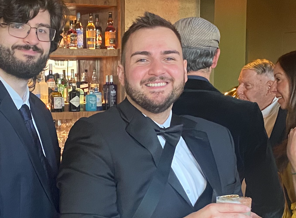
Not yet 15 months into the job and Gavin Fontanez has a full plate. The first and only executive director of the Greater Westhampton Historical Museum, Fontanez has overseen the complete revamp on the website to make it more user friendly. He is shepherding the historical society through its transition to adding a museum component and also is overseeing the Society’s many activities associated with the 250th anniversary of the United States.
“Before this, I’d only worked seasonally for museums,” says Fontanez, who graduated from Stony Brook University with a masters degree as a history teacher. He also has a masters in museum studies from Johns Hopkins. “We were only a historical society until about two months before I was hired. With the addition of being a museum, we have additional responsibilities to public education programs, events and to also bringing in a younger crowd.”
“We know that we have to change the public’s perception of who and what we are,” says Fontanez, who grew up in Manorville. “People think of historical societies as these musty places full of cobwebs and things from their grandmother. These groups today are so much more. People need to take a fresh view of historical societies. We have new exhibits that change seasonally, are topical and try to look at history in different ways.”
The museum covers the following areas, Westhampton, Westhampton Beach, Westhampton Dunes, Quiogue, East Quogue, Remsenburg, Speonk and Eastport. The campus, which is at 101 Mill Road in Westhampton Beach, includes the Tuthill House Museum, an 1840 farmhouse that offers a glimpse into early local life; Thurston Raynor Milk House, a glimpse of Long Island’s agricultural roots, the house was moved to the grounds in 2005 and showcases rural ingenuity such as a hand-cranked cream separator and ice-cooled cellar; The Meeker Carriage House & Privy, this 1845 structure that includes a two-seater privy was donated in 2008 and displays antique farm tools and an Amish courting carriage, offering a glimpse into daily life and historic craftsmanship; and The Foster-Meeker House, the oldest home in Westhampton Beach (circa 1735), currently finishing reconstruction using original timber and period techniques, will immerse visitors in colonial life.
“We recently had the ‘Eye of the Storm’ exhibit, which covered major storms on Long Island from the 1938 hurricane to Sandy” Fontanez says. “We also had an antique toy exhibit that was very nostalgic and warm.”
At 26 years old, he is the youngest person working at the Historical Society. He doesn’t plan for things to stay that way. He’s hoping to attract new volunteers and docents for the 250th activities. He also hopes that younger blood will help shape how they present history.
“Younger people see history differently, and are more interested in how history affects them today” Fortunez explains. He also wants to highlight the indigenous, African American history of women of the area.
“So much of history is white and male,” says Fortanez, who doesn’t want to erase that aspect of the area’s history. He simply wants a more well-rounded view of the area. “I want to enhance the history we currently have, to share with everyone things they may not know. We have to share the perspectives of the groups that weren’t as well represented in the Western history books.”
He said he also wants to have more collaboration with other museums in the area, as well as showcase what their coverage area has to offer.
“We’re still adjusting to the title of Museum,” Fontanez says with a laugh. “We also want to highlight some of the forgotten history in the area, women’s history, oral histories. Our summer people likely don’t know as much about the vast history of this area. We were the place to go before The Hamptons. We became a tourism destination after the addition of an LIRR stop in the 1870s. We changed from farming and fishing to beachy. We became a party destination in the 1980s-90s. There is that history. There’s also the colonial history. Many people think of Sag Harbor and the whaling history. The farming history was rich and complex but doesn’t get as much attention. The area was a lot more diverse than people realize.
“There’s always the question of how far back is considered history,” Fontanez asks? “I wouldn’t say that we will appeal just to older people. To a younger age group, history is the 1900s, as it gets older it’s the 1800s. Again, how far back is history? That is a question we will have to answer differently to different demographics.”
A major goal is to make people aware of their new charter, while assuring those who love what the Historical Society does so well will still be front and center. More important is to bring more volunteers into the fold to assist with all the events they have planned this summer.
“It is going to take a lot of volunteers and docents and we’re going to need to start training people now because there is a lot to know and learn,” Fontanez says. “We’re already asking people to sign up.”
Those activities will include:
May 30: The American Craft Fair, highlighting the 250th anniversary of the United States, 10 a.m.-2 p.m., on the Great Lawn, Potunk Lane and Main Street in Westhampton Beach, period crafts and skills, silversmithing, what life was like, wool spinning, farming, candle making, historic cooking, colonial games and historic music
June 4: New exhibit, celebrating America and looking back at its identity and celebrations
June 11: “Anchored in History” Gala and auction fundraiser, at the Westhampton Yacht Squadron, 4-7 p.m., 9 Yacht Club Dr., Remsenburg, Tickets are available online.
July and August: Summer craft demonstration weekends, last two weekends in July and first two weekends in August, demonstrations appropriate for all ages
Sept 25-26, Annual Art Show, local and area artists, preview and auction, meet the artists and learn more about the history of the art community in the area
“I have learned so much about being an executive director,” Fontanez says. “I’ve learned so much from the trustees, the staff and volunteers. They know a lot about the history of the area. The biggest thing I’ve learned is time management. Things take longer than you expect. And, despite having a masters, I can still be humbled by the amount I don’t know and everyone else does know.”
The museum is regularly open 10 a.m.-2 p.m. Monday-Friday, and its hours will change as it transitions into the summer. For more information about events and volunteer opportunities, visit whbhistorical.org, call 631-288-1139 or email office@whbhistorical.org
Todd Shapiro is an award-winning publicist and associate publisher of Dan’s Papers.
Vetted Hamptons Resources